What is spin-orbit interaction? Calculate the energy shift due to spin-orbit interaction term in H-like system. Discuss the significance of this shift in relation to the fine structure of hydrogen spectral lines.
State and explain the Heisenberg's uncertainty principle. Show that the natural line width of a spectral line follows from this principle. The lifetime of an excited state of an atom is 10^{-8}\text{ s}. Calculate the energy width of such a state.
Describe Stern--Gerlach experiment. In performing this experiment, beams of neutral atoms are used. Why are electrons or ion beams not used ? Explain how it demonstrates the discrete nature of the magnetic moment of an atom.
Set up the time-independent Schrödinger equation for an electron moving in a Coulomb field, V(r) = \frac{-ze^2}{4\pi\varepsilon_0 r}, in polar coordinates. Solve the radial equation to get the energy eigen values.
Set up a time-independent Schrödinger equation for a linear harmonic oscillator and obtain the energy eigen values. Explain the significance of zero point energy.
A system is described by the Hamiltonian operator, H=-\dfrac{d^2}{dx^2}+x^2. Show that the function A x\exp\left(-\dfrac{x^2}{2}\right) is an eigen function of H. Determine the eigen values of H.
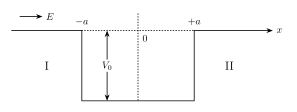
A stream of particles of mass M and energy E is directed from left to a one-dimensional potential well, as shown below :
The potential is -V_0 in the region a \ge x \ge -a and zero elsewhere. Set up a time-independent Schrödinger equation and obtain an expression for the transmission ratio from region I to II. Discuss the result. Show that there is a finite reflection from such a potential well, which is a result of the wave nature of matter.
Estimate the number of states lying in an energy interval of 0.03\text{ eV} above the Fermi level in a potassium crystal of unit volume. (E_F = 2.12\text{ eV} for potassium)
Derive Bohr's angular momentum quantization condition in Bohr's atomic model from the concept of de Broglie waves.
Show that the Pauli spin matrices satisfy the following: \sigma_x^2=\sigma_y^2=\sigma_z^2=1 \sigma_x\sigma_y=-\sigma_y\sigma_x=i\sigma_z \sigma_y\sigma_z=-\sigma_z\sigma_y=i\sigma_x \sigma_z\sigma_x=-\sigma_x\sigma_z=i\sigma_y
The electron spin operator \hat{s} can be expressed in matrix form in terms of the Pauli spin operator, \hat{\sigma} as \hat{\sigma} = 2\hat{s} where \sigma_x = \begin{pmatrix} 0 & 1 \\ 1 & 0 \end{pmatrix}, \quad \sigma_y = \begin{pmatrix} 0 & -i \\ +i & 0 \end{pmatrix}, \quad \sigma_z = \begin{pmatrix} 1 & 0 \\ 0 & -1 \end{pmatrix} Show that \sigma_x^2 = \sigma_y^2 = \sigma_z^2 = 1 \quad \text{and} \sigma_x \sigma_y = -\sigma_y \sigma_x = i \sigma_z \sigma_y \sigma_z = -\sigma_z \sigma_y = i \sigma_x \sigma_z \sigma_x = -\sigma_x \sigma_z = i \sigma_y
The normalized wave function for the electron in hydrogen atom for the ground state is \psi(r)=(\pi a_0^3)^{-1/2}\exp\left(-\frac{r}{a_0}\right) Where a_0 is the radius of the first Bohr orbit. Show that the most probable position of the electron is a_0.
\questiondiagram{} A stream of particles of mass M and energy E is directed from left to a one-dimensional potential barrier as shown in the above figure. Set up the time-independent Schrodinger equation and obtain an expression for transmission probability from region I to II. How this phenomenon helps in the understanding of \alpha-decay of nuclei?
Calculate the change in pressure for a change in freezing point of water equal to -0.91^\circ\mathrm{C}. Given, the increase of specific volume when 1 gm of water freezes into ice is 0.091 cc/gm and latent heat of fusion of ice is 80 cal/gm.
1 kmol of an ideal gas is compressed isothermally at 400 K from 100 kPa to 1000 kPa in a piston and cylinder arrangement. Calculate the entropy change of the gas, the entropy change of the surroundings and the total entropy change resulting from the process if the process is mechanically reversible and the surroundings consist of a heat reservoir at 400 K.
Consider one mole of an ideal gas whose pressure changes with volume as P=\alpha V, where \alpha is a constant. If it is expanded such that its volume increases m times, find the change in internal energy, work done by the gas and heat capacity of the gas.
Derive an expression for the thermal efficiency of a reversible heat engine operating on the Diesel cycle with an ideal gas of constant heat capacity as the working medium.
Explain why the distribution of speeds of molecules emerging through a small hole in an effusive molecular beam source is not a Maxwellian distribution.
(ii) -\left(\dfrac{\partial f}{\partial E}\right) is symmetric about the Fermi level.
Let f be the Fermi-Dirac distribution function, then show that--- (i) -\left(\dfrac{\partial f}{\partial E}\right) is a maximum at the Fermi level;