Distinguish between Einstein and Debye models of specific heats of solids. Obtain an expression for the specific heat of a solid on the basis of Debye model. Discuss the results for low and high temperature ranges.
Distinguish between classical and quantum theory of paramagnetism. Explain the paramagnetism of free electrons on the basis of F.D. distribution.
Discuss the motion of an electron in an allowed energy band under the influence of an external electric field. Obtain an expression for the effective mass of the electron and discuss its variation in the band.
What is Josephson tunnelling? Distinguish between a.c. and d.c. Josephson effects.
In one experiment, a perfect conductor and a superconductor are cooled to below 1\text{ K} and then a magnetic field is applied. In another experiment, they are cooled to below 1\text{ K} in magnetic field. Describe their responses in these two experiments and explain.
What is a Josephson junction ? Explain the phenomenon of tunneling of charge carriers across such a junction. Discuss DC and AC Josephson effects. Mention some applications of this device.
Show the variation of magnetization with applied magnetic field for type I and type II superconductors. Describe their behaviour. Discuss their potential for various applications.
Draw a two stage RC coupled transistor amplifier. Plot the frequency response and indicate the lower and upper cut off frequencies and the bandwidth.
Using the collector characteristics of a bipolar junction transistor, show how you can use it as a switch with one ON and one OFF state. Plot and describe the operation of this circuit for a sinusoidal input.
Describe the essential parts of an oscillator circuit using a block diagram. Design a Colpitts oscillator set to a frequency of 1500\text{ Hz} and explain how your design incorporates the essential parts of the oscillator circuit.
Employing NAND gates, design a half adder circuit which can add two bits A and B and provide a sum S and a carry C as its output.
\questiondiagram{} Identify the above op-amp circuit. Estimate the net output voltage V_0.
The resistance of silicon and germanium varies with temperature. But these are not used normally as thermistors. Why ? Name at least two widely used materials for making thermistors and give any five applications of thermistor.
Silicon is the most popular semiconductor material used for the fabrication of electronic devices and integrated circuits. Why ? Give at least five reasons.
A type-II superconducting material with superconducting transition temperature T_c is placed in a magnetic field. What is the material state (normal or superconducting or mixed) for (i) T < T_c ; \quad H > H_{c_2} (ii) T > T_c ; \quad H < H_{c_1} (iii) T < T_c ; \quad H_{c_1} < H < H_{c_2} (iv) T < T_c ; \quad H < H_{c_1} (v) T > T_c ; \quad H > H_{c_2} where H_{c_1} and H_{c_2} are the lower and upper critical fields for a type-II superconductor.
What is Meissner effect ? Explain the conclusions drawn from the Meissner effect.
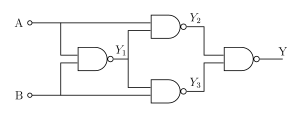
Verify that the circuit shown below is an exclusive OR.
What do you understand by early effect in bipolar junction transistors ? What are its consequences ? Discuss briefly the advantage of using the BJT in the common collector configuration.
Show that the reciprocal lattice of a hexagonal lattice is a hexagonal lattice with a rotation of axes.
Which of the waves out of (i) X-rays, (ii) de-Broglie waves due to electrons or neutrons will be suitable for crystal diffraction ? Justify your answer in terms of energies of these waves for 0 \cdot 1 \text{ nm}.