1381ifos-2014-subject-05-004
Paper II8 Marks
Normalize the ground state wave function \psi_0(x) = A e^{(-\alpha x^2/2)} for the simple harmonic oscillator and find expectation values \langle x \rangle and \langle x^2 \rangle.
Search, filter, and study UPSC Civil Services & IFoS Physics past year questions with rigorous derivations, formulas, and step-by-step solutions.
Buy PYQ Solution Manual →
Normalize the ground state wave function \psi_0(x) = A e^{(-\alpha x^2/2)} for the simple harmonic oscillator and find expectation values \langle x \rangle and \langle x^2 \rangle.
Derive an expression for transmission coefficient for a particle through a rectangular potential barrier.
Write down Pauli spin matrices. Express J_x,J_y and J_z in terms of Pauli spin matrices.
Show that
(i) no two of the three components of angular momentum operator commute and
(ii) the third component of the angular momentum operator commutes with the square of angular momentum operator.
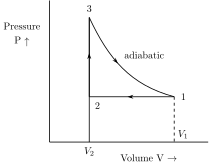
The figure below represents an imaginary ideal gas cycle. Assuming constant heat capacities, show that the thermal efficiency is : \eta = 1 - Y \frac{(V_1/V_2) - 1}{(P_3/P_2) - 1}
Show that both Fermi-Dirac and Bose-Einstein distribution functions at an energy E are given by: f(E) \simeq \exp\left[\frac{\mu-E}{k_{\mathrm B}T}\right], where f(E) is much smaller than unity, \mu and k_{\mathrm B}T are the chemical potential and thermal energy of the atom.
Explain the four thermodynamic relations of Maxwell. Using the same, obtain the Clausius-Clapeyron equation \frac{\mathrm{d}P}{\mathrm{d}T}=\frac{L}{T(V_2-V_1)}.
For a degenerate Fermi-Dirac gas, the concentration of nucleons in nuclear matter is N = 1.1 \times 10^{38}\text{ cm}^{-3}. Calculate the Fermi energy and Fermi temperature.
Derive an expression for the Fermi energy for a free electron gas at T = 0. Compute the Fermi temperature of Cu assuming the density 9\text{ gms/cm}^3 and one conduction electron per atom.
One kg of water at 20^\circ\mathrm{C} is converted into ice at -10^\circ\mathrm{C} at constant pressure. Heat capacity of water is 4{,}200\ \mathrm{J\,kg^{-1}\,K^{-1}} and that of ice is 2{,}100\ \mathrm{J\,kg^{-1}\,K^{-1}}. Heat of fusion of ice at 0^\circ\mathrm{C} is 335\times10^3\ \mathrm{J\,kg^{-1}}. Calculate the total change in entropy of the system.
Define Enthalpy and show that it remains constant in a throttling process.
Consider a system of free gas particles having f degrees of freedom. Use equipartition theorem to establish the relation f=\frac{2}{\left(\dfrac{C_p}{C_V}-1\right)}, where C_p and C_V are molar specific heats at constant pressure and constant volume respectively. Obtain the values of \dfrac{C_p}{C_V} for diatomic and triatomic gases.
Show that the elemental quantity of heat dQ is not a total differential.
An inductance L, capacitance C and resistance R are connected in series to form a circuit with AC source driving with E_{\text{rms}} = 120\text{ V} at f = 60\text{ Hz}. Compute the power factor and average power dissipated in the resistance if R = 200\ \Omega, X_L = 80\ \Omega and X_C = 150\ \Omega.
In deriving radiation laws, we consider a cubical container of volume V containing a photon gas in equilibrium. Calculate the differential number of allowed normal modes of frequency \omega.
State and explain Stefan-Boltzmann Law. Show that \log P = \log K + 4\log R, where P is the power emitted by black body and R is the resistance of the black body, K is a constant.
Prove Stefan's law of radiation from thermodynamic considerations.
Suppose a cavity of volume V contains blackbody radiation in equilibrium with the walls of the cavity at a temperature T. For a reversible adiabatic change of volume show that : VT^3 = \text{constant}. If the initial temperature is 2000^\circ\text{K} and the volume is increased from 10\text{ cm}^3 to 1250\text{ cm}^3, reversibly and adiabatically, what would be the final temperature of the radiation ?
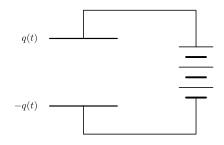
A parallel plate capacitor is connected to a battery. What is the electric current while the capacitor is being charged ? What is the displacement current between the plates of the capacitor ? Show that the rate of increase of the electric energy is equal to the surface integral of the Poynting vector over the surface enclosing the volume between the plates of the capacitor.
A plane electromagnetic wave of frequency w_1 travelling in z-direction and polarized in x-direction is incident on a dielectric medium separated by a plane boundary in the x-z plane. Show that the transmission and reflection coefficient are given by : R = \frac{(n_1 - n_2)^2}{(n_1 + n_2)^2} , \quad T = \frac{4 n_1 n_2}{(n_1 + n_2)^2} , where n_1 and n_2 are the refractive indices of the first and the second medium.