Calculate the focal lengths of the components of an achromatic telescope objective having a power of +3\cdot 333 diopter, made from crown glass and flint glass, whose dispersive powers are 0\cdot 012 and 0\cdot 02 respectively.
What do you mean by spherical aberration of a lens? Show that if two plano-convex lenses are kept at a distance equal to the difference of their focal lengths, the spherical aberration would be minimum.
When the two waves of nearly equal frequencies interfere, then show that the number of beats produced per second is equal to the difference of their frequencies.
(i) Give the equation of motions for a particle executing simple harmonic motion for undamped, damped and forced vibrations, and explain the terms.
(ii) Give a plot between the displacement and time for each case of the above and interpret.
(iii) What are the conditions for critical damping and resonance?
Show that the wave equation for the propagation of electromagnetic scalar potential \phi(x, y, z, t) \left[\nabla^2 - \frac{1}{c^2} \frac{\partial^2}{\partial t^2}\right] \phi(x, y, z, t) = 0 remains invariant under Lorentz transformation.
In special theory of relativity, the Hamiltonian of a free particle with rest mass m_0 is given by \sqrt{p^2 c^2 + m_0^2 c^4}. Obtain the Lagrangian of the system using Legendre transformation.
Calculate the first relativistic correction to the kinetic energy of a particle with rest mass m_0 and speed v.
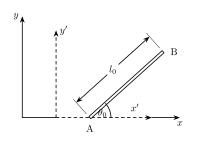
A rod of length l_0 is kept at rest in x'\,y' plane of its rest frame making an angle \theta_0 with x' axis. What is the length and orientation of the rod in a laboratory frame (x,y) in which the rod moves to the right with velocity v?
A particle of mass m is constrained to move on a plane curve xy=c with c>0, under gravity, where y-axis is vertical. Construct the Lagrangian of the system and obtain the Euler-Lagrange equation of motion.
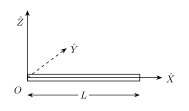
A rod of length L has non-uniform linear mass density (mass per unit length) \lambda, which varies as \lambda=\lambda_0\left(\dfrac{S}{L}\right); where \lambda_0 is a constant and S is the distance from the end marked `O' (as shown in the figure). Find the centre of mass of the rod.
(i) If a particle of mass m is in a central force field f(r)\hat{r}, then show that its path must be a plane curve, where \hat{r} is a unit vector in the direction of position vector \vec{r}.
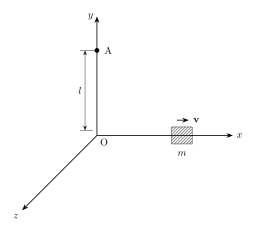
(ii) A block of mass m having negligible dimension is sliding freely in x-direction with velocity \vec{v}=v\hat{\imath} as shown in the diagram.
What is its angular momentum \vec{L}_O about origin O and its angular momentum \vec{L}_A about the point A on y-axis?
A water drop of radius 0.04\ \mathrm{mm} is falling through air. If the coefficient of viscosity for air is 1.8 \times 10^{-4} poise, find its terminal velocity. If 100 such drops coalesce, what will be the new terminal velocity?
Two capillary tubes of lengths 2l and l with internal radii r and 2r respectively are connected in series. Water flows through them in streamline. If the pressure difference across the first capillary is P, find the pressure difference across the second one.
Use Gauss's theorem to calculate the gravitational potential due to a solid sphere at a point outside the sphere. Calculate the amount of work required to send a body of mass m from the Earth's surface to a height R/2, where R is the radius of the Earth.
A particle moving in a central force field located at r=0, describes a spiral, r=e^{-\theta}. Find the force law.
Consider a homogeneous cube of total mass M and side a. Taking the origin at one corner of the cube and axes along the edges of the cube, construct the moment of inertia tensor. Calculate principal moment of inertia.
Why does the resistance of a semiconductor decrease with increase in temperature ?
Explain with the help of a neat diagram the working of an RC coupled common emitter amplifier.
Determine the values of emitter current and the collector current of the transistor having \alpha = 0\cdot98 and collector to base leakage current I_\text{CBO} = 4\ \mu\text{A}. The base current is 50\ \mu\text{A}.
Define the terms critical magnetic field and critical temperature in a superconductor. Find the magnetic field strength necessary to destroy the superconductivity in a sample of lead at 4\cdot2\text{ K}. The critical magnetic field at 0\text{ K} is 0\cdot80\text{ Tesla} and the critical temperature is 7\cdot2\text{ K}.