
A single, slit of width 0.14\text{ mm} is illuminated normally by monochromatic light and diffraction bands are observed on a screen 2\text{ m} away. If the centre of the second dark band is 1.6\text{ cm} from the middle of the central bright band deduce the wavelength of light.
Write down the differential equation for a damped simple harmonic oscillator. Solve it and discuss the characteristics of dead-beat motion.
Nine Kilograms of mercury is poured into a glass U-tube of uniform internal diameter of 1.2\text{ cm}. It oscillates freely about its equilibrium position. Calculate the period of oscillation.
Two transverse sine waves each of amplitude 4\text{ mm} wavelength 2\text{m} and time period 1\text{ s} and in-phase at x=0, t=0 are travelling along the x-axis in opposite directions. Obtain the equation of the resultant wave and comment on its nature. Calculate the maximum displacement at x=2.3\text{ m}. Also locate the antinodes and nodes.
For a certain wave, system the angular velocity \omega and the wave vector k are related as follows: \omega = \omega_0 \left| \sin \frac{k a}{2} \right| \quad \text{for } -\frac{\pi}{a} < k < \frac{\pi}{a} Determine and plot the phase velocity and the group velocity for this system.
Write a note on Ruby laser.
Explain mathematically how left and right circularly polarized light is produced by combining two linearly polarized beams. Given a beam of light, how can one experimentally test whether it is unpolarized or circularly polarized?
Write down Lorentz transformation relations and prove that x^2 + y^2 + z^2 - c^2 t^2 is invariant under this transformation. An event occurs at x^1 = 60\text{ m} at t^1 = 8 \times 10^{-8}\text{ s} in a reference frame S' which is moving along the common x or x' axis with a speed 3c/5 with reference to a stationary from S. The origins of the two frames coincide at t=0, t'=0. Deduce the space time coordinates of the event in the frame S.
Prove the addition theorem of velocities in Special Theory of Relativity. Two bodies A and B are moving away in opposite directions each with a speed of 0.70\text{ c} with respect to a stationary observer. Deduce the speed or B as measured by A.
Write a note on Experimental verification of variation of mass with velocity.
A thin uniform rod of length l and mass m is hinged to the floor at its lower end. It begins to fall from a vertical position. Deduce an expression for the angular speed of the road when it hits the floor. How would you explain that the rod would suffer less damage if the floor is soft than if the floor is hard?
A satellite moves round the earth at a distance of 3.884 \times 10^5\text{ km} from its centre. Find its period of revolution in days. Proceed dto deduce the distance for a geostationary satellite.
State Kepler's laws of planetary motion. Assume the law of gravitation to be of the form F = mMG/r^n where n is some number. Find the value n which will be consistent with Kepler's third law. For this you may assume planetary orbits to be circular.
Write a note on Gyroscope and its applications.
A neutron of energy 1.00\text{ MeV} collides with a stationary helium nucleus and is scattered. Deduce the momentum of the neutron and the helium nucleus in their centre of mass system.
A pipe of varying diameter is used to lift water by 7\text{ m} the area of cross-section of the base is 125\text{ cm}^2 and the pressure here is 2.5 \times 10^5\text{ N/m}^2. The area of cross-section of the top is 25\text{ cm}^2. The rate of flow of water is 3 \times 10^{-2}\text{ m}^3/\text{s}. Calculate the pressure of water at the top neglecting energy losses.
Define differential, scattering cross-section. Write down the dependence of Rutherford scattering cross-section \sigma(\theta), on the scattering angle \theta and sketch this dependence graphically. In the present case, the total scattering cross-section, \sigma = \int \sigma(\theta) d\Omega turns out to be infinite. Comment on this result.
State the difference in the electronic energy states in an isolated atom and in a solid. Hence explain difference between a conductor, an insulator and an intrinsic semiconductor. What is the role of impurities in so-called extrinsic semiconductors?
Considering the electrons in the atom, what is the difference between a diamagnetic and a paramagnetic substance? State how magnetic the susceptibility varies with temperature for dia, para, ferro- and anti-ferro-magnetic materials. (No theoretical discussion required.)
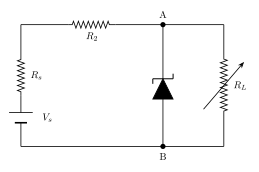
What is a Zener diode? Explain what function it performs in the circuit given below as the load resistance R_L is varied. What is the purpose of introducing resistor R_2 in the circuit? (V_s and R_s represent source voltage and resistance, respectively).
