
Explain processional motion of a top. A solid sphere of radius 2\text{ cm} and mass 50\text{ gm} has a thin nail of length 5\text{ mm} fixed perpendicular to its surface. When this sphere spins like a top with a speed of 20 rev./second what will be its processional speed?
Write a short note on Coriolis force and its effects.
Write a short note on Motion of rocket.
In the ammonia molecule the three hydrogen atoms form an equilateral triangle. The distance between the centre of this triangle from each hydrogen atom is 0.939\text{ \AA}. The nitrogen atom is at the apex of the pyramid with the three hydrogen atoms forming the base. The distance between the hydrogen and nitrogen atoms is 1.014\text{ \AA}. Find the position of the centre of mass relative to the nitrogen atom.
The tides in oceans on Earth are produced by gravitational pull of the Sun and the Moon. The pull due to Sun is much greater than the pull due to Moon. Explain, why tides due to Sun are only about 0.4 times as high as that due to Moon. The mass of the Sun is 2 \times 10^7 times the mass of the Moon and the distance between Sun and Earth is 400 times the distance between Moon and Earth. The radius of the Earth is 6.4 \times 10^6\text{ m}.
Define ex-OR. Give its truth table and draw the possible logic blocks.
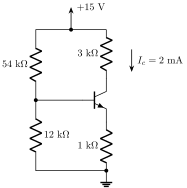
A Si BJT is connected as shown Fig . Show that it is in active region and works as an amplifier Calculate its mid frequency gain, given that BJT has h_{ie} = 1\text{ k}\Omega, h_{oe} = h_{re} = 0, I_{co} = 20\text{ nA}.
Derive the expression for the frequency spectrum of a carrier wave of frequency f_c which is amplitude modulated by a frequency f_m. A certain transmitted radiates 9\text{ kW} of power when the carrier wave is unmodulated and 10.12\text{ kW} power when the carrier wave is sinusoidally modulated. Calculate the modulation index.
Define parity for a quantum mechanical system. Describe an appropriate experiment proving the parity violation in weak interaction. How can the parity violation in weak interaction be understood ? Explain.
Taking only the spin motion of electron, proton and neutron and assuming them as point particles, obtain their magnetic moments. How far the values thus obtained agree with experimental values? If not, why? Explain.
Write a comparative account of the following four processes: (i) \beta - decay (ii) positron emission (iii) electron capture (iv) inverse \beta- decay
Write a short note on Stellar spectra.
Calculate the bond length and force constant of the bond of ^{12}\text{C}\ ^{16}\text{O} molecule; given 0 \rightarrow 1 rotational line in v = 0 state is at 115.3\text{ GHz} and the wavelength of the vibrational frequency is 14.7\ \mu\text{m}.
Describe Frank Hertz experiment to establish the quantization of energy levels.
Explain the fine structure of H_\alpha line of H-atom arising due to LS coupling.
Calculate the velocity and direction of recoil electron for back scattered X-ray photon of \text{Mo } K_\alpha of 0.707\ \text{\AA} in Compton effect.
An electron moving with energy E encounters one dimensional potential step as given below: V(x) = 0 \quad x < 0 \qquad V(x) = V_0 \quad x > 0 (a) Suppose the electron has the energy E > V_0 and is incident from (-x) direction, find the normalized wave function so corresponds to unit incident flux. (b) Solve the above problem for the case E < V_0 and discuss the significance of the result with the help of a suitable example.
What is Brownian motion? Deduce Einstein's formula for translatory Brownian motion of particles suspended in a liquid and hence determine the avogadro's number.
A vacuum of the order of 10^{-11}\text{ cm of Hg} is obtained in the laboratory. Estimate the number of molecules of gas per cobic centimeter at 27^\circ \text{C} in that vacuum.
Using Maxwell's thermodynamic relations show that the internal energy of an ideal gas at a constant temperature is independent of its volume while for a real gas it is a function of Volume also.
