2181cse-2003-subject-08-001
Paper II30+30 Marks
What is a Josephson junction ? Discuss dc and ac Josephson effects and obtain the relation. V = \frac{2eV}{h} where the symbols have their usual meaning.
Search, filter, and study UPSC Civil Services & IFoS Physics past year questions with rigorous derivations, formulas, and step-by-step solutions.

What is a Josephson junction ? Discuss dc and ac Josephson effects and obtain the relation. V = \frac{2eV}{h} where the symbols have their usual meaning.
Calculate the gain of the following amplifier circuit :
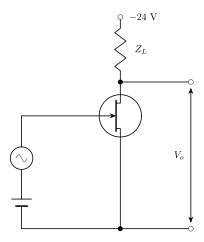
Given that g_m = 10\text{ mV/A}, r_d = 1\ \Omega and Z_L = 10\text{ k}\Omega.
Derive the various current components in a p-n-p transistor when it is actively biased. Using Ebers-Moll model, show that for the common-emitter configuration I_C = -\alpha I_E - I_{CO} \left(E^{V_C/V_T} - 1\right) where the symbols have the usual meaning.
Give two characteristics properties of strange par- tides which distinguish them from non-strange ones. Write the Gellmann-Nishijima relation and show how it is used for the classification of elementary particles.
(i) State the conservation law which is violated in each of the following processes: (1) n \rightarrow p + e^- + r (2) \pi^- + p \rightarrow K^+ + K^- (3) \pi^- + p \rightarrow \Sigma^+ + K^- (4) \Sigma^- \rightarrow K^- + p + \bar{p} (ii) Draw a bcc lattice. Determine its primitive lattice vectors and calculate the packing fraction.
List some of the important properties of deuteron and show that it is a loosely bound system and has only one bounded state.
Sketch carefully the binding energy per nucleon curve for stable nuclei. Explain its salient features. On the basis of this curve explain why fusion is possible only for low mass nuclei, whereas fission takes place in heavy nuclei.
Distinguish between a nuclear reaction and decay. Which conservation laws are obeyed in nuclear reactions ? Explain the significance of Q value. Calculate the Q value for the following nuclear reaction: ^2_1 H + ^2_1 H \rightarrow ^3_2 H + n.
Discuss the salient features of O, P, Q, R and S branches of electronic spectrum of diatomic molecules. Which spectrum contains only branches, both branches and bands, branches and progressions ?
Define the gyromagnetic ratio and obtain an expression for the Lande g factor. What is the importance of g factor in spectroscopy?
(i) What are the typical energies (eV) of the radiations, required to excite (i) electronic transitions. (ii) vibrational transitions and (iii) rotational transitions in a molecule ? (ii) The rotational spectrum of HI consists of equidistant lines with a separation of 12.8\text{ cm}^{-1}. Calculate the (a) M.I. and (b) bond length of HI molecule.
(i) Explain what do you understand by Heisenberg uncertainty principle. Using this principle, determine the energy of the ground state of a one dimensional simple harmonic oscillator. (ii) An electron having an energy 2 eV is travelling in the region where V(x) varies as shown below:
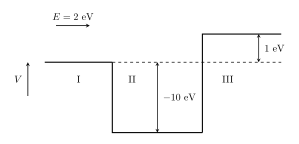
Calculate the de Broglie wavelength of the electron in regions I, II and III.
A particle of mass m, with energy E such that -V_0 < E < 0, is trapped in a potential wall as shown below :
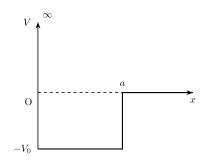
Write time independent Schrodinger equation in regions (i) 0 < x < a and (ii) x > a.
(i) Show that the radial probability density of the ground state of the hydrogen atom has a maximum at r = a. The ground state wave function of the hydrogen atom is given by \psi (r) = \frac{1}{\sqrt{\pi a^{3/2}}} e^{-r/a} where a is the Bohr radius. (ii) Calculate the Larmor frequency of a spin 1/2 particle in a magnetic field B.
= 0$. What is the significance of this commutation relation ? (ii) Show that the Pauli Matrices anti-commute.
Obtain an expression from which the energy eigen values can be determined.
Number at non-interacting electrons are confined in a cube of volume L^3. Obtain an expression for the Fermi energy.
Show that for at least one bound state to exist. a^2 V_0 \ge \frac{h^2 \pi^2}{8m}
Define Fermi energy. For an ideal Fermi gas of N particles at absolute zero temperature, show that the total energy of is 3/5 N E_F, where E_F is the Fermi energy.
Describe the Otto cycle and obtain an expression for the efficiency of the cycle, Show that the efficiency is lower than that of a Carnot cycle operating between the highest and the lowest temperature of Otto cycle.