2121cse-2005-subject-02-006
Paper I20 Marks
(d) Drawing a neat diagram, discuss how light travels through an optical fibre. Show that the numerical aperture of a commercially available optical fibre is around 0.25. Explain its physical significance.
Search, filter, and study UPSC Civil Services & IFoS Physics past year questions with rigorous derivations, formulas, and step-by-step solutions.

(d) Drawing a neat diagram, discuss how light travels through an optical fibre. Show that the numerical aperture of a commercially available optical fibre is around 0.25. Explain its physical significance.
Differentiates between Rayleigh and Raman scatterings. Why is Raman scattering considered to be a breakthrough in molecular spectroscopy ? What are the advantages of using laser light in Raman spectroscopy ?
(b) What is the essential difference between interference and diffraction of light ? How can you achieve Fraunhofer diffraction in the laboratory ? Using the concept of Fraunhofer diffraction at a single slit, find out the intensity distribution produced by two slits of equal width.
(b) For a transverse sinusoidal wave of wavelength \lambda propagating along negative x direction through a string fixed at a point, show that the nodes are located at x = 0, \lambda/2, \lambda, 3\lambda/2, \dots while the kinetic energy / unit length at the antinodes is given by E = 2 \rho A^2 \omega^2 \cos^2 \omega t where \rho, A and \omega, are the mass density / unit length, amplitude of transverse displacement and angular frequency of the wave, respectively.
(b) What are constraints of motion ? Explain with examples the holonomic and non-holonomic constraints. Discuss critically how can one overcome the limits of constraints by introducing generalised coordinates.
(a) How are linear and angular momenta related to each other ? Considering a system of mass points under the influence of forces derived from potentials only, prove that the generalised linear momentum is conserved. Establish further that the angular momentum of the above system is also conserved if the potential is centrally symmetric.
(b) Show that the mass-energy relationship in relativistic kinematics can lead to the equation E^2 = c^2 p^2 + m_0^2 c^4 where E is the total energy of the particle of rest mass m_0, linear momentum p and moving with a velocity v; c is the velocity of light in free space.
What is the principle used in 'half-adder' ? Give the truth table for it.
Draw a circuit diagram of an R-C phase shift oscillator. Explain its working. Derive an expression for its frequency.
Give the two forms of the De Morgan's theorem.
A transistor with \beta = 50, V_{BE} = 0.7\text{ V}, V_{CC} = 22.5\text{ V} and R_c = 5.6\text{ k}\Omega is used in biasing circuit as shown in the figure. It is designed to establish the quiescent potential at V_{CE} = 12\text{ V}, I_C = 1.5\text{ mA} and stability factor S \le 3. Find the values of resistors R_E, R_1 and R_2, where symbols have their usual meanings.
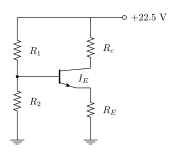
(i) The following information is included on the data sheet for an N-channel JFET : I_{DSS} = 20\text{ mA}, V_p = -8\text{V} and g_{mo} = 5000\text{ }\mu\text{s} Determine the value of drain current and trans-conductance at V_{GS} = -4\text{ V}.
Show that the condition of periodicity of lattice leads to the Bloch theorem. What is a Bloch function ?
Write down the Bethe-Weizsäcker mass formula. Explain various terms of the formula.
(i) Which of the following reactions are allowed and forbidden under the conservation of strangeness, conservation of baryon number and conservation of charge ? \pi^+ + n \rightarrow \Lambda^\circ + K^+ \pi^+ + n \rightarrow K^\circ + K^+ \pi^- + p \rightarrow \Lambda^\circ + K^+ \pi^- + p \rightarrow \pi^\circ + \Lambda^\circ (ii) By drawing E vs. \vec{k} curve, distinguish between metal, insulator and semiconductor.
(i) State the quantum numbers I_z, Y and S for the uds quarks and antiquarks. What combination of these leads to the formation of (a) proton and (b) neutron ?
If x and p_x are two conjugate variables, show that [[UNCLEAR]] duce 4 watts and the amount of energy that is released in the complete fissioning of 1\text{ kg} of {}^{235}\text{U}. (Assume energy released per fission of {}^{235}\text{U} is 200\text{ MeV}.)
Explain how energy is released in stars.