A transparent film of glass of refractive index 1\cdot 5 is introduced normally in the path of one of the interfering beams of Michelson interferometer which is illuminated with light of wavelength 5893\text{ \AA}. This causes 500 dark fringes to shift across the field. Determine the thickness of the film.
What is damped harmonic oscillation? Write the equation of motion and obtain the general solution for this oscillation. Discuss the cases of dead beat, critical damping and oscillatory motion based on the general solution. What would be the logarithmic decrement of the damped vibrating system, if it has an initial amplitude 30\,\mathrm{cm}, which reduces to 3\,\mathrm{cm} after 20 complete oscillations?
What is achromatism ? Obtain the condition for achromatism of two thin lenses separated by a distance of x metres.
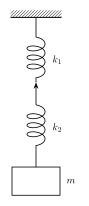
A mass m is suspended by two springs having force constants k_1 and k_2 as shown in the figure. The mass m is displaced vertically downward and then released. If at any instant t, the displacement of the mass m is x, then show that the motion of the mass is simple harmonic motion having frequency f=\frac{1}{2\pi}\sqrt{\frac{1}{m}\left(\frac{k_1k_2}{k_1+k_2}\right)}
What is chromatic aberration? Obtain the condition for achromatism using combination of two thin lenses placed in contact to each other. Can this system work as achromatic doublet if both are of same material? Justify your answer.
Two glasses have dispersive powers in the ratio 2 : 3. These glasses are used in the manufacture of an achromatic contact objective of focal length 50\text{ cm}. What are the focal lengths of the lenses ?
Show that the phenomenon of Fraunhofer diffraction at two vertical slits is modulation of two terms viz. double slit interference and single slit diffraction. Obtain the condition for positions of maxima and minima.
In a step-index optical fiber system, explain the terms pulse dispersion and material dispersion. An optical fiber having refractive indices of core and cladding n_1 = 1.463 and n_2 = 1.444 respectively, uses a Laser diode with \lambda_0 = 1.50\,\mu\mathrm{m} with a spectral width of 2\,\mathrm{nm}. At this wavelength if the material dispersion coefficient, D_{m} is 18.23\,\mathrm{ps/(km\cdot nm)}, then calculate the pulse dispersion and material dispersion for 1\,\mathrm{km} length of the fiber.
What is the Resolving power of a grating ? Obtain an expression for the Resolving power of a grating, based on Rayleigh's criterion of resolution.
(i) Obtain an expression for the displacement of the damped harmonic oscillator where the damping force is proportional to the velocity. Discuss the effect of the damping on the displacement and frequency of the oscillator. Discuss the difference physically between overdamped and critically damped by taking example of a pendulum. (ii) A particle of mass 3 moves along the x-axis attracted towards the origin by a force whose magnitude is numerically equal to 12x. The particle is also subjected to damping force whose magnitude is numerically equal to 12 times the instantaneous speed. If it is initially at rest at x = 10, find the position and the velocity of the particle at any time.
Write an expression for the profile (t = 0) of a harmonic wave moving in the +x-direction such that at x = 0, \psi = 10; at x = \lambda/6, \psi = 20 and at x = 5\lambda/12, \psi = 0. (The notations carry usual meanings)
A glass chamber 25\text{ mm} long filled with air is positioned in front of one of the secondary sources in Young's experiment. The air is removed from the chamber and a test gas is entered in its stead. On comparing the fringe system corresponding to air with that of the test gas, it is found that the entire interference pattern on the screen was displaced by 21 bright bands towards gas-containing chamber. Given that \lambda = 656{\cdot}2816\text{ nm} for which the refractive index of air is n_a = 1{\cdot}000276. Determine the refractive index of the gas (n_g).
The equation for displacement (X) of a point on a damped oscillator is given by x = 5e^{-0.25t}\sin\left(\frac{\pi}{2}\right)t\ \text{metres}. Find the velocity of oscillating point at t = \frac{T}{4} and T, where T is the time period of the oscillator. What is the direction of velocity in each case?
Briefly discuss the postulates of Einstein to explain stimulated emission. Derive an expression for Einstein's A and B coefficients and show that the ratio of coefficients of spontaneous versus stimulated emission is proportional to the third power of frequency of radiation. Why is it difficult to achieve laser action in higher frequency ranges such as X-rays? Can there be a temperature at which the rates of spontaneous and stimulated emission are equal? Illustrate with wavelength \lambda = 5000\,\mathring{\mathrm{A}}.
What is a zone plate? Give its theoretical description. Show that a zone plate has multiple foci. Differentiate a zone plate from a convex lens. Calculate the radius of the first half period zone in a zone plate behaving like a convex lens of focal length 60\,\mathrm{cm} for light of wavelength 6000\,\mathring{\mathrm{A}}.
For free space show that electromagnetic (EM) wave is transverse in nature. Show that for free space, the total outward flux of EM energy through surface S bounding volume V is equal to the rate of loss of EM energy from the volume V. A laser beam of 2\ \mathrm{mm} diameter has average power of 20\ \mathrm{GW}. Calculate the peak values of electric and magnetic fields in the laser beam.
State and explain Fermat's principle of extremum path. Discuss the cases of rectilinear propagation of light and reversibility of light rays in context of Fermat's principle. Using Fermat's principle, deduce the thin lens formula.
Discuss the conditions for interference. Describe Young's double-slit experiment and derive an expression for the estimation of fringe width. Discuss its dependency on various parameters. Green light of wavelength 5100\,\mathring{\mathrm{A}} from a narrow slit is incident on a double-slit. If the overall separation of 10 fringes on a screen 200\,\text{cm} away is 2\,\text{cm}, find the slit separation.
Consider the formation of Newton's rings when two closely spaced wavelengths are present, for example, the \text{D}_1 and \text{D}_2 lines of sodium (\lambda_1 = 5890\text{ \AA} and \lambda_2 = 5896\text{ \AA}). What will be the effect of the presence of these two wavelengths as the lens is gradually moved away from the plate? What will happen if the sodium lamp is replaced by a white source? (The radius of curvature of the lens, R = 100\text{ cm})
What are Newton's rings? How are they formed by two curved surfaces?