(b) What is the essential difference between interference and diffraction of light ? How can you achieve Fraunhofer diffraction in the laboratory ? Using the concept of Fraunhofer diffraction at a single slit, find out the intensity distribution produced by two slits of equal width.
(c) What do you understand by paraxial rays ? Show that the effect of translation of a paraxial ray while travelling along a homogeneous medium is represented by a 2 \times 2 matrix if the ray is initially defined by a 2 \times 1 matrix.
(c) Explain how Einstein's A and B coefficients are related to the phenomena of spontaneous and stimulated emission of radiation, respectively. Derive the relation between A and B. Establish that at very high frequency around X-ray wavelength regime, lasers cannot be made as easily as at low frequencies, e.g. far infra-red regime.
(c) Why does one see two image points for a single object point while viewed through a calcite crystal ? What is this property of the crystal known as ? What is an optic axis of a crystal ? Explain the meanings of positive and negative crystals with one example for each kind.
(d) Drawing a neat diagram, discuss how light travels through an optical fibre. Show that the numerical aperture of a commercially available optical fibre is around 0.25. Explain its physical significance.
- (a) Why does one get three-dimensional image in holography ? Explain with appropriate figures how can one construct and read a hologram.
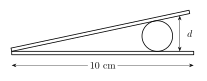
Two microscope slides of length 10 cm each form a wedge. At one end they are in contact and at the other end they are separated by a thin wire of diameter d (see the diagram below). Interference fringes are obtained when illuminated vertically by a monochromatic light of \lambda = 500\text{ nanometers}. The fringe spacing is found to be 1.25 cm. Estimate the diameter of the wire.
Differentiates between Rayleigh and Raman scatterings. Why is Raman scattering considered to be a breakthrough in molecular spectroscopy ? What are the advantages of using laser light in Raman spectroscopy ?
Water vapor shows Infrared absorption bands at 1595\text{ cm}^{-1}, 3652\text{ cm}^{-1} and at 3756\text{ cm}^{-1}. If the Raman spectrum is observed with the Argon Ion Laser 514.5\text{ nm}, at what wavelengths would you expect to find the Raman Stokes lines ?
A quartz quarter wave plate is to be used with the sodium light (\lambda = 5896\text{ \AA}). What should be its thickness ?
Write down the equation of motion for a damped harmonic oscillator assuming the damping force proportional to the velocity of the particle. Obtain the general solution for its displacement as a function of time. Discuss the cases of 'overdamping', 'under-damping' and 'critical damping'.
A siren of frequency 900 Hz is going towards a wall away from an observer at a speed 10 m/sec. Determine : (i) Frequency of sound directly heard from the siren. (ii) Frequency of sound reflected from the wall. (iii) Number of beats per second heard by the observer. (Velocity of sound = 330 m/sec)
A narrow slit illuminated by monochromatic light of \lambda = 6400\text{ \AA} is placed at a distance of 3 metres from a straight edge. If the distance between the straight edge and the screen is 6 metres, calculate the distance between the first and the fourth dark bands.
A thin converging lens and a thin diverging lens are placed coaxially at a distance of 5 cm. If the focal length of each lens is 10 cm, find for the combination (i) the focal length, (ii) the power, (iii) the positions of the principal points.
Show that the ratio of the focal lengths of the two lenses in an achromatic doublet is given by \frac{f_1}{f_2} = - \frac{w_1}{w_2} where w_1 and w_2 are the dispersive powers of the lenses of focal lengths f_1 and f_2 respectively.
How does Doppler effect of light of relativistic physics qualitatively differ from its non-relativistic analogue ? Calculate the Doppler shift in the frequency of a photon travelling along the y-axis. with respect to an observer moving along the x-axis with a constant speed v.
Obtain an expression for the intensity of light in the Fraunhofer diffraction pattern due to a circular aperture. What is Airy pattern ? Explain with a neat diagram.
Explain the phenomenon of self focusing of laser beams.
Explain the phenomenon of pulse dispersion in a step index optical fibre.
What is holography ? Describe the experimental set up for Gabor's on-line holographic recording. What are the limitations of Gabors experiments? How these were over come by Leith and Upatneiks?