m gram of water at temperature T_1 is isobarically and adiabatically mixed with an equal mass of water at temperature T_2. Show that the change in entropy is given by \Delta S=2mC_p\ln\left(\dfrac{T_{\mathrm{av}}}{T_{\mathrm{geo}}}\right), where T_{\mathrm{av}}=\dfrac{T_1+T_2}{2} and T_{\mathrm{geo}}=\sqrt{T_1T_2}.
Plot the Fermi distribution function versus energy at temperatures T = 0 and T > 0. Explain the nature of the former curve on the basis of the Pauli principle.
Derive an expression for the total number of particles N in an ideal Bose gas at any temperature T. Hence, obtain the relation N_0 = N \left[ 1 - \left( \frac{T}{T_0} \right)^{\frac{3}{2}} \right] for the number of particles N_0 in the ground state at T < T_0, the Bose-Einstein condensation temperature, and draw N_0 versus T curve.
Start from the equation T dS = C_p dT - T \left( \frac{\partial V}{\partial T} \right)_P dP and get the relation \left( \frac{\partial C_p}{\partial P} \right)_T = -T \left( \frac{\partial^2 V}{\partial T^2} \right)_P Hence, show that the third law of thermodynamics requires for the coefficient of thermal expansion of any substance to vanish at T = 0.
Discuss the consequence following from Joule's free expansion experiments in the context of the internal energy of an ideal gas.
For a Van der Waals gas, write down the equation of state. Determine the coefficient of critical expansion \beta.
The vapour pressure of an organic substance is 50\times10^3\ \mathrm{Pa} at 40^{\circ}\mathrm{C}. Its normal boiling point is 80^{\circ}\mathrm{C}. If the substance in vapour phase can be treated like an ideal gas, find the latent heat of vaporization of the substance.
A Van der Waals gas undergoes Joule-Kelvin expansion with a pressure drop of 50\ \mathrm{atm}. If its initial temperature is 300^{\circ}\mathrm{K}, determine its final temperature. (Given Van der Waals constant a=0.136\ \mathrm{Pa\,m^6\,mol^{-1}}, b=36.5\times10^{-6}\ \mathrm{m^3\,mol^{-1}}, C_p=30\ \mathrm{J\,K^{-1}\,mol^{-1}}, R=8.3\ \mathrm{J\,K^{-1}\,mol^{-1}}.)
Show that both Fermi-Dirac and Bose-Einstein distribution functions at an energy E are given by: f(E) \simeq \exp\left[\frac{\mu-E}{k_{\mathrm B}T}\right], where f(E) is much smaller than unity, \mu and k_{\mathrm B}T are the chemical potential and thermal energy of the atom.
For a degenerate Fermi-Dirac gas, the concentration of nucleons in nuclear matter is N = 1.1 \times 10^{38}\text{ cm}^{-3}. Calculate the Fermi energy and Fermi temperature.
Derive an expression for the Fermi energy for a free electron gas at T = 0. Compute the Fermi temperature of Cu assuming the density 9\text{ gms/cm}^3 and one conduction electron per atom.
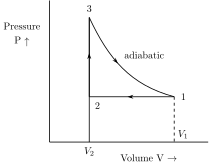
The figure below represents an imaginary ideal gas cycle. Assuming constant heat capacities, show that the thermal efficiency is : \eta = 1 - Y \frac{(V_1/V_2) - 1}{(P_3/P_2) - 1}
Explain the four thermodynamic relations of Maxwell. Using the same, obtain the Clausius-Clapeyron equation \frac{\mathrm{d}P}{\mathrm{d}T}=\frac{L}{T(V_2-V_1)}.
Consider a system of free gas particles having f degrees of freedom. Use equipartition theorem to establish the relation f=\frac{2}{\left(\dfrac{C_p}{C_V}-1\right)}, where C_p and C_V are molar specific heats at constant pressure and constant volume respectively. Obtain the values of \dfrac{C_p}{C_V} for diatomic and triatomic gases.
One kg of water at 20^\circ\mathrm{C} is converted into ice at -10^\circ\mathrm{C} at constant pressure. Heat capacity of water is 4{,}200\ \mathrm{J\,kg^{-1}\,K^{-1}} and that of ice is 2{,}100\ \mathrm{J\,kg^{-1}\,K^{-1}}. Heat of fusion of ice at 0^\circ\mathrm{C} is 335\times10^3\ \mathrm{J\,kg^{-1}}. Calculate the total change in entropy of the system.
Define Enthalpy and show that it remains constant in a throttling process.
Show that the elemental quantity of heat dQ is not a total differential.
What is transport phenomenon ? Obtain the expression for the coefficient of viscosity. Discuss its temperature dependence.
In Leh, temperature of ice on a cold winter night is measured as -20^\circ\mathrm{C}. Calculate the change in entropy when 1\ \mathrm{kg} of ice is converted into steam at 100^\circ\mathrm{C}. Given specific heat capacity of ice is 500\ \mathrm{cal\,kg^{-1}\,K^{-1}}, latent heat of ice is 3.36\times10^5\ \mathrm{J\,kg^{-1}}, latent heat of steam is 2.26\times10^6\ \mathrm{J\,kg^{-1}} and J=4.2\ \mathrm{J\,cal^{-1}}.
State Dulong-Petit's law and discuss its limitations in explaining heat capacities of solids. How were these efficiencies overcome by Debye ?