101cse-2017-subject-04-006
Paper I15 Marks
Write and explain the Maxwell-Boltzmann distribution. Using this distribution, find the expressions for the most probable speed, mean speed and root-mean-square speed.
Search, filter, and study UPSC Civil Services & IFoS Physics past year questions with rigorous derivations, formulas, and step-by-step solutions.
Buy PYQ Solution Manual →
Write and explain the Maxwell-Boltzmann distribution. Using this distribution, find the expressions for the most probable speed, mean speed and root-mean-square speed.
Derive the mathematical expression for the total energy of a degenerate Fermi gas at a temperature T and calculate the specific heat of the Fermi gas at this temperature.
State Maxwell's distribution law of molecular speeds. Draw and explain a curve between n(c) and c in a gas at a given temperature T, where n(c) dc is the number of molecules having speed between c and c + dc. Discuss the effect of T and mass m of the molecule on the nature of the curve.
Prove the thermodynamic relation : \left( \frac{\partial S}{\partial V} \right)_T = \left( \frac{\partial P}{\partial T} \right)_V and hence show that \frac{\mathrm{d}P}{\mathrm{d}T} = \frac{L}{T (V_2 - V_1)} ; all the terms have their usual meanings.
A reversible engine converts 1/6 of the heat input into work. When the temperature of the sink is reduced by 62\ ^{\circ}\mathrm{C}, its efficiency is doubled. Find the temperatures of source and sink.
Calculate the critical temperature for helium, given the values for critical constants, a = 6.15 \times 10^{-5}, b = 9.95 \times 10^{-4}, where the unit of pressure is atm and the sample is kept at NTP.
Derive Clausius-Clapeyron equation. How does it explain the effect of pressure on melting point of solids and boiling point of liquids?
1 litre of hydrogen at 127^{\circ}\mathrm{C} and 10^{6} dynes \mathrm{/cm}^{2} pressure expands isothermally until its volume is doubled and then expands adiabatically until its volume is redoubled. Calculate the resulting pressure. \gamma = 1.42
The molecules of a gas obeying Maxwell-Boltzmann distribution move with an average speed of 450\ \mathrm{m\ s^{-1}}. If the coefficient of viscosity of the gas \eta is 16.6\times10^{-6}\ \mathrm{N\,s\,m^{-2}}, density of the gas \rho is 1.25\ \mathrm{kg\ m^{-3}} and number density is 2.7\times10^{25}\ \mathrm{m^{-3}}, calculate the mean free path and diameter of the gas molecules.
Write down the expression for the Bose-Einstein distribution function and explain the meaning of the symbols used.
The molecules of a gas obey Maxwell-Boltzmann distribution. Calculate the fraction of molecules of the gas within 1\% of the most probable speed at STP. Interpret your result.
Derive the expression for the specific heat of a solid based on Einstein's theory. Obtain the limiting form of the specific heat at very low temperature.
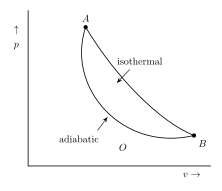
A quasistatic isothermal and quasistatic adiabatic intersect in a p-v diagram at more than one point as shown in diagram. Does it imply violation of 2nd law of thermodynamics ? Give reasons for your answer.
The mean speed of the molecules of an ideal monatomic gas when it contracts (or expands) adiabatically depends on the pressure according to the law v = K p^n, where K is a constant. Find n.
The viscosity in a liquid arises due to friction between adjacent layers. What causes viscosity in a gas? Explain.
Write down the salient features of the Einstein's theory of lattice heat capacity. Further write down the expression for specific heat in Einstein's theory and explain its high and low temperature limits.
What do you understand by the term 'phase transition'? Using Clausius-Clapeyron equation, show that for first-order phase transitions, vapour pressure decreases exponentially with temperature. You can assume that the vapour behaves like an ideal gas and latent heat remains constant with temperature.
Write down van der Waals' equation of state for n moles of a gas and calculate the temperature at which 5 moles of the gas at 5\ \mathrm{atm} pressure will occupy a volume of 20 litres. Given, R=8.31\times10^7\ \mathrm{erg\,mol^{-1}\,K^{-1}}, a=1.34\times10^{12}\ \mathrm{dyne\,cm^4\,mol^{-2}}, b=31.2\ \mathrm{cm^3\,mol^{-1}} and 1\ \mathrm{atm}=1.013\times10^6\ \mathrm{dyne\,cm^{-2}}.
m gram of water at temperature T_1 is isobarically and adiabatically mixed with an equal mass of water at temperature T_2. Show that the change in entropy is given by \Delta S=2mC_p\ln\left(\dfrac{T_{\mathrm{av}}}{T_{\mathrm{geo}}}\right), where T_{\mathrm{av}}=\dfrac{T_1+T_2}{2} and T_{\mathrm{geo}}=\sqrt{T_1T_2}.
A system of non-interacting fermions enclosed in a volume, V, is at T = 0^\circ\text{K}. Find an expression for the internal energy, U, of the system.