One mole of gas obeys van der Waals equation of state. If its molar internal energy is given by u=cT-a/V (in which V is the molar volume, a is one of the constants in the equation of state and c is a constant), calculate the molar heat capacities C_v and C_p.
$. Consider \left|\frac{T_f-T_i}{T_f}\right|<1.
What do you understand by negative temperature? Write and explain various restrictions on a system for the concept of negative temperature to be meaningful.
Assume that the Earth's atmosphere is pure nitrogen in thermodynamic equilibrium at a temperature of 300\ \mathrm{K}. Calculate the height above sea level at which the density of the atmosphere is one-half its sea level value. (Molecular weight of \mathrm{N}_2 is 28\mathrm{gm/mole})
Calculate the Fermi energy of aluminium at absolute zero. The density of aluminium is 2\cdot 7 \times 10^3\text{ kg m}^{-3} and its atomic weight is 26\cdot 98\text{ kg (k mol)}^{-1}. Show that the electron gas in aluminium is strongly degenerate.
A gas of interacting atoms has an equation of state and heat capacity at constant volume given by the expressions p(T,V)=aT^{1/2}+bT^3+cV^{-2} C_v(T,V)=dT^{1/2}+eT^2V+fT^{1/2} where a through f are constants which are independent of T and V. Find the differential of the internal energy dU(T,V) in terms of dT and dV.
In the case of a gas obeying the equation of state \frac{\text{Pv}}{\text{RT}} = 1 + \frac{\beta}{\text{v}}, where \beta is a function of T only, find the expression of the heat capacity at constant volume.
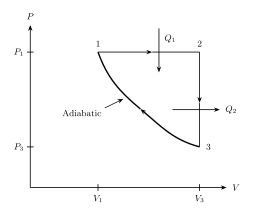
A hypothetical engine, with an ideal gas as the working substance, operates in the cycle shown below. Show that the efficiency of the engine is \eta = 1 - \frac{1}{\gamma} \left( \frac{1 - \dfrac{P_3}{P_1}}{1 - \dfrac{V_1}{V_3}} \right) .
Calculate the work done in expanding one mole of an ideal gas at 127^\circ\text{C} to double its initial volume.
Consider one gm of ice at a temperature T_1\text{ K}. Show that when this ice changes into steam at a temperature T_2\text{ K}, the total gain in entropy is \Delta S = \frac{L_i}{T_1} + C \log_e \left( \frac{T_2}{T_1} \right) + \frac{L_s}{T_2} where L_i is latent heat of ice, C is specific heat of water, L_s is latent heat of steam. T_1 = 273\text{ K}.
Calculate the efficiency of an engine having compression ratio 13.8 and expansion ratio 6 and working on diesel cycle. Given \gamma = 1.4.
Write a brief note on Chandrasekhar Limit.
The melting point of tin is 232^{\circ}\mathrm{C}, its latent heat of fusion is 14\ \mathrm{cal/g} and the specific heat of solid and molten tin are 0.055 and 0.064\ \mathrm{cal/g}\,^{\circ}\mathrm{C} respectively. Calculate the change in entropy when 1.0\mathrm{gm} of tin is heated from 100^{\circ}\mathrm{C} to 300^{\circ}\mathrm{C}.
Calculate the critical constants for \mathrm{CO_2} for which the Van der Waals constants are given by a=0.0072 and b=0.002. Also calculate the Boyle's temperature of \mathrm{CO_2}. The unit of pressure is atmosphere and the unit of volume is that of a gm-mole of the gas at NTP.
Using the expression for internal energy U = 3N \frac{\hbar\omega}{e^{\hbar\omega/k_B T}-1}, show that Einstein specific heat capacity is given by; C = 3R \left(\frac{\hbar\omega}{k_B T}\right)^2 \frac{e^{\hbar\omega/k_B T}}{\left(e^{\hbar\omega/k_B T}-1\right)^2} Also show that Einstein specific heat capacity given above is proportional to e^{-\hbar\omega/k_B T} at very low temperature.
Write the expression for the Fermi-Dirac distribution. Plot the Fermi-Dirac distribution at T=0 and for T_1>T_2>0. Now from the plot propose two alternative definitions of the Fermi level.
How many nitrogen molecules must strike a 1\text{ cm}^2 surface each second to exert a pressure of 1\text{ atmosphere} ? (Assume the molecules are all moving at same speed, corresponding to a temperature of 300\text{ K}, and at an angle of 45^\circ to the wall). [Molecular mass of \text{N}_2 is 28\text{ u}]
Find the pressure at which water would boil at 150^\circ\text{C} if the change in specific volume when one gm of water is converted into steam is 1676\text{ c.c.} Given J = 4\cdot 2 \times 10^7\text{ ergs/cal}, one atmosphere = 10^6\text{ dyne/cm}^2 and latent heat of vapourisation of steam = 540\text{ cal/gm}.
Eight indistinguishable balls are to be arranged in six distinguishable boxes. Calculate the total number of ways in which the above can be done.
Calculate the probability of an electron occupying an energy level 0.02\,\mathrm{eV} above the Fermi level at T=300\,\mathrm{K}