21cse-2024-subject-04-005
Paper I5 Marks
What do you understand by macrostates and microstates? Briefly explain.
Search, filter, and study UPSC Civil Services & IFoS Physics past year questions with rigorous derivations, formulas, and step-by-step solutions.
Buy PYQ Solution Manual →
What do you understand by macrostates and microstates? Briefly explain.
Deduce the thermodynamic relation : \left(\frac{\partial S}{\partial V}\right)_T = \left(\frac{\partial P}{\partial T}\right)_V Using the expression establish Clausius-Clapeyron latent heat equation \frac{dP}{dT} = \frac{L}{T(V_2 - V_1)}
The specific heat of a solid at low temperatures is given by the relation C_V = AT^3, where A is a constant and T is the absolute temperature. How much heat will be required to raise the temperature of m\text{ gm} of the solid from 300\text{ K} to 500\text{ K}?
Prove that the work done by a perfect gas during a quasi-static adiabatic expansion is given by W = \frac{P_i V_i}{\gamma - 1} \left[ 1 - \left( \frac{P_f}{P_i} \right)^{\frac{\gamma - 1}{\gamma}} \right] where \gamma is the ratio of specific heats.
The volume of a mole of liquid \text{He}^4 is 27 \times 10^{-6}\text{ m}^3 and the mass of a \text{He}^4 atom is 6.65 \times 10^{-27}\text{ kg}. Assuming that liquid \text{He}^4 is an ideal Bose gas, calculate (i) the concentration of boson in this volume. (ii) Bose temperature.
Find out the boiling temperature of water at the top of Mount Everest. Given : Pressure at the top of Everest is 0.36\text{ atm}. The density of water vapour at 100^\circ\text{C} is 0.598\text{ kg/m}^3. The latent heat is 2.257 \times 10^3\text{ J/g}.
Explain how the state of ionization of any particular element in a star changes with varying temperatures and pressures.
Explain how we can produce refrigeration without using a compressor.
Write down the expressions for the Fermi-Dirac distribution and the Bose-Einstein distribution. Plot the distributions as a function of the energy.
Use the Maxwell-Boltzmann distribution to find the number of oxygen molecules whose velocities lie between 195\text{ m/s} and 205\text{ m/s} at 0^\circ\text{C}. The given mass of oxygen gas is 0\cdot1\text{ kg}. (Assume mass of proton to be 1\cdot66 \times 10^{-27}\text{ kg})
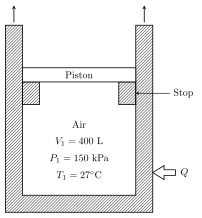
A piston-cylinder device initially contains air at 150\text{ kPa} and 27^\circ\text{C}. At this state, the piston is resting on a pair of stops, as shown in the figure, and the enclosed volume is 400\text{ L}. The mass of the piston is such that a 350\text{ kPa} pressure is required to move it. The air is now heated until the volume is doubled. Determine : (i) the final temperature, (ii) the work done by the air, and (iii) the total heat transferred to air. Given : U_{300\text{ K}} = 214\text{ kJ/kg} and U_{\text{final}} = 1113\text{ kJ/kg} Gas constant of air, R = 0\cdot287\text{ kPa.m}^3/\text{kg.K}
(i) Define Joule-Kelvin coefficient. Write it in its mathematical form. (ii) Determine the Joule-Kelvin coefficient for a van der Waals gas. Hence, obtain an expression for temperature of inversion. Discuss the conditions under which heating or cooling is produced.
Using Zeroth law of thermodynamics, introduce the concept of temperature. Explain how the isotherms of two different systems can be drawn.
Distinguish between a perfect gas and a real gas. Derive van der Waals' equation of state and use it to obtain the expressions for the critical constants in terms of the constants of the van der Waals' equation.
What is the concept of negative temperature in statistical mechanics? Explain in brief.
A gas of interacting atoms has an equation of state and heat capacity at constant volume given by the expressions p(T,V)=aT^{1/2}+bT^3+cV^{-2} C_v(T,V)=dT^{1/2}+eT^2V+fT^{1/2} where a through f are constants which are independent of T and V. Find the differential of the internal energy dU(T,V) in terms of dT and dV.
Assume that the Earth's atmosphere is pure nitrogen in thermodynamic equilibrium at a temperature of 300\ \mathrm{K}. Calculate the height above sea level at which the density of the atmosphere is one-half its sea level value. (Molecular weight of \mathrm{N}_2 is 28\mathrm{gm/mole})
One mole of gas obeys van der Waals equation of state. If its molar internal energy is given by u=cT-a/V (in which V is the molar volume, a is one of the constants in the equation of state and c is a constant), calculate the molar heat capacities C_v and C_p.
Two Carnot engines \text{C}_1 and \text{C}_2 operate in series, Engine \text{C}_1 absorbs heat at T and rejects heat to a sink at temperature 300\text{ K}. Engine \text{C}_2 absorbs \frac{1}{4}\text{th} of the heat rejected by engine \text{C}_1 and rejects heat to the sink at 200\text{ K}. If the work done in both the cases is the same, find the temperature T.
$