21ifos-2025-subject-08-004
Paper II8 Marks
What is Josephson effect? How can Josephson junctions be used to produce macroscopic quantum interference?
Search, filter, and study UPSC Civil Services & IFoS Physics past year questions with rigorous derivations, formulas, and step-by-step solutions.
Buy PYQ Solution Manual →
What is Josephson effect? How can Josephson junctions be used to produce macroscopic quantum interference?
Explain the cause of hysteresis phenomenon in ferromagnetic materials. What does the area of the hysteresis loop signify?
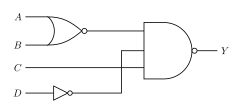
What is Boolean algebra? State De Morgan's theorems and determine the output expressions for the circuit shown below by using De Morgan's theorems :
(i) Give a qualitative description of the BCS theory and explain how it accounts for the superconducting state. (ii) The critical field of niobium is 1 \times 10^5\text{ A/m} at 8\text{ K} and 2 \times 10^5\text{ A/m} at absolute zero. Find the transition temperature of the element.
What is an oscillator? Explain the Barkhausen criterion and working principle of an R-C phase-shift oscillator with suitable circuit diagram.
What is a microprocessor? Briefly mention the basic units of a microprocessor by drawing descriptive block diagram of 8085 microprocessor.
Classify diamagnetic, paramagnetic and ferromagnetic materials in terms of their magnetic susceptibility (\chi). Plot and explain the variation of \frac{1}{\chi} with temperature for the three materials.
Consider an energy band which is filled with electrons up to a certain value k_1 \left(k_1 < \frac{\pi}{a}\right). Determine the total effective number of free electrons in the energy band. Comment on the electron distribution in an insulator, intrinsic semiconductor and metals at 0\text{ K}. Symbols have their usual meanings.
In powder diffraction method pattern for lead with radiation of wavelength \lambda = 1\cdot 54 \text{ \AA}, the (220) Bragg reflection angle is \theta = 32^\circ. Find the radius of the atom.
What is a microprocessor? Describe the internal functioning of a microprocessor with block diagrams.
(i) How will you obtain OR gate from NAND gate? Draw the logic circuit for the following expressions : Y = ABC + \bar{D} Y = (\bar{E}G + B)H (ii) What is a thermistor? Explain the working of thermistor by drawing temperature-resistance curve.
An RC-coupled transistor amplifier has mid-frequency gain A_{\text{vm}} = 100. The values of the lower and upper cut-off frequencies are f_1 = 20\text{ Hz} and f_2 = 50\text{ kHz}. Find the frequencies at which the gain is reduced to 80.
Compare the working of FET and MOSFET with their structure, I-V curve and transfer characteristics.
How does supercritical magnetic field depend on temperature ? For a superconducting specimen, the critical magnetic fields are respectively 1\cdot 45 \times 10^5\text{ A/m} and 4\cdot 2 \times 10^5\text{ A/m} for 14\text{ K} and 13\text{ K}. Determine the superconducting transition temperature and the critical field at 0\text{ K}.
(ii) Recalculate the intrinsic carrier concentration at T = 450\text{ K} by assuming that the effective electron and hole masses in the respective bands decrease by 0\cdot 5\%.
State the characteristics of an ideal Op-Amp. Explain the use of an Op-Amp as a summing amplifier and a differentiator.
Given that for intrinsic Si at T = 300\text{ K}, the band gap is 1\cdot 1\text{ eV} and the intrinsic carrier concentration is n_i = 1\cdot 5 \times 10^{10}\text{ cm}^{-3}. (i) Calculate the intrinsic carrier concentration at T = 450\text{ K}. Assume that the band gap at T = 450\text{ K} is 1\cdot 08\text{ eV}.
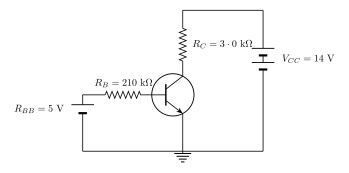
The n\text{-}p\text{-}n transistor given below has \beta = 100, I_{CO} = 12\text{ nA} and V_{BE} = 0\cdot 8\text{ V}. Determine the transistor currents and the region of operation of the transistor. What happens if R_C is indefinitely increased?
Consider the planes with indices (1\ 0\ 0) and (0\ 0\ 1); the lattice is f.c.c., and the indices refer to the conventional cubic cell. What are the indices of these planes when referred to the primitive axes : \vec{a}_1 = \frac{a}{2}(\hat{x}+\hat{y}), \vec{a}_2 = \frac{a}{2}(\hat{y}+\hat{z}) and \vec{a}_3 = \frac{a}{2}(\hat{z}+\hat{x})?
The spacing between successive (100) planes in sodium chloride is 1\cdot 41\text{ \AA}. X-rays incident on the surface of the crystal are found to give rise to second order Bragg reflections at a glancing angle 10^\circ. Calculate the wavelength of X-ray radiations.