Comment Done
Navigation
HomePYQs Question BankCSE Physics OptionalIFoS Physics OptionalBlog & InsightsCourses & ProgrammesMy Courses (Candidate Portal)
Account

PYQ Bank

353

Search, filter, and study UPSC Civil Services & IFoS Physics past year questions with rigorous derivations, formulas, and step-by-step solutions.

Buy PYQ Solution Manual →
PYQ Blueprint Art
/
20 questions visible on this page
Shortcuts: / filter, Esc reset
301cse-1999-subject-08-003
CSE 1999Paper II20 Marks

Phosphorous is doped in a silicon wafer. The impurity concentration is 10^{13}\text{ per cm}^3. If all the donors are active calculate its resistivity at room temperature. The mobility of electrons is 1250\text{ cm}^2/\text{V-s}.
Full Thread
302cse-1999-subject-08-002
CSE 1999Paper II20 Marks

How is frequency modulation advantageous compared to amplitude modulation? Still, why are the video signals transmitted by television stations amplitude modulated?

Full Thread
303cse-1999-subject-08-001
CSE 1999Paper II20 Marks

What is Meissner effect? Superconducting tin has a critical temperature of 3.7 K in zero magnetic field and critical field at 0 K is 306 gauss. Determine the critical field at 2K.

Full Thread
304cse-1998-subject-08-003
CSE 1998Paper II20 Marks

Explain the working N-P-N transistor. Derive expression for the current and voltage gains.

Full Thread
305cse-1998-subject-08-002
CSE 1998Paper II20 Marks

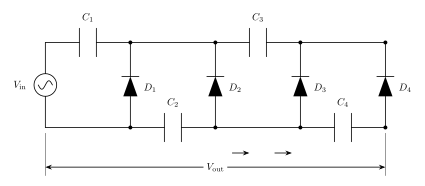
If E_0 is the peak value of the input voltage V_{in} calculate the output voltage V_{out}.

Physics Diagram cse-q-8-170-fig-1
Full Thread
306cse-1998-subject-08-001
CSE 1998Paper II20 Marks

Distinguish qualitatively between dia-, para-, ferro-, antiferro- and ferrimagnetism. How is the weak and temperature independence paramagnetism of metals explain?

Full Thread
307cse-1998-subject-08-004
CSE 1998Paper II20 Marks

What is the photovoltaic mode of operation for a photo-diode? Describe the construction and working of a silicon solar cell.

Full Thread
308cse-1998-subject-08-005
CSE 1998Paper II20 Marks

Simplify the following logic function and draw the corresponding logic diagram:- Y = (A+B).(A + C).(B+C)

Full Thread
309cse-1997-subject-08-002
CSE 1997Paper II20 Marks

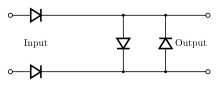
Four silicon diodes are connected as shown in Fig. 1. A sinusoidal voltage of amplitude 2\text{ V} is applied in the input. What is the waveshape of the output and its amplitude? If the amplitude of the input voltage is reduced to 1\text{ V}, what will be the waveshape of the output and its amplitude ? Threshold voltage of each diode is 0.6\text{ V}.

Physics Diagram cse-q-8-167-fig-1
Full Thread
310cse-1997-subject-08-005
CSE 1997Paper II30 Marks

Simplify the following logic function and draw the corresponding logic gates: Y = A.B + B.\overline{C} + \overline{A}.B + \overline{A}.C + \overline{B}.\overline{C} + \overline{A}.\overline{B}.\overline{C} + A.B.C

Full Thread
311cse-1997-subject-08-003
CSE 1997Paper II30 Marks

Draw the circuit of an emitter-follower and find its voltage gain.

Full Thread
312cse-1997-subject-08-004
CSE 1997Paper II20 Marks

Explain the basic distinction between a perfect conductor and a superconductor.

Full Thread
313cse-1997-subject-08-001
CSE 1997Paper II20 Marks

Assuming that for a paramagnetic material, the magnetic susceptibility is inversely proportional to temperature in Kelvin, obtain Curie-Weiss law for the paramagnetic phase of a ferro-magnetic material.

Full Thread
314cse-1996-subject-08-003
CSE 1996Paper II30 Marks

Define ex-OR. Give its truth table and draw the possible logic blocks.

Full Thread
315cse-1996-subject-08-001
CSE 1996Paper II20 Marks

Derive the expression for the frequency spectrum of a carrier wave of frequency f_c which is amplitude modulated by a frequency f_m. A certain transmitted radiates 9\text{ kW} of power when the carrier wave is unmodulated and 10.12\text{ kW} power when the carrier wave is sinusoidally modulated. Calculate the modulation index.

Full Thread
316cse-1996-subject-08-002
CSE 1996Paper II30 Marks

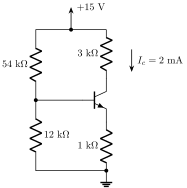
A Si BJT is connected as shown Fig . Show that it is in active region and works as an amplifier Calculate its mid frequency gain, given that BJT has h_{ie} = 1\text{ k}\Omega, h_{oe} = h_{re} = 0, I_{co} = 20\text{ nA}.

Physics Diagram cse-q-8-166-fig-2
Full Thread
317cse-1995-subject-08-002
CSE 1995Paper II30 Marks

Draw the block diagram of a superhetro dyne radio receiver and explain the function of local oscillator.

Full Thread
318cse-1995-subject-08-001
CSE 1995Paper II20 Marks

How does build in potential appear across a p-n junction? Explain under what biasing conditions drift and diffusion currents, respectively, dominate.

Full Thread
319cse-1995-subject-08-003
CSE 1995Paper II30 Marks

Establish the two Barkhausen conditions for sustained sinusoidal oscillations. Sketch the circuit of Wien's bridge oscillator and explain its working.

Full Thread
320cse-1994-subject-08-004
CSE 1994Paper II30 Marks

Draw a circuit using AND, OR and NOT gate to realize the following truth table: \begin{array}{|c|c|c|c|} \hline \multicolumn{3}{|c|}{\text{INPUTS}} & \text{OUTPUT} \\ \hline A & B & C & Y \\ \hline 0 & 0 & 0 & 0 \\ 0 & 0 & 1 & 1 \\ 0 & 1 & 0 & 1 \\ 1 & 0 & 0 & 1 \\ 0 & 1 & 1 & 0 \\ 1 & 0 & 1 & 0 \\ 1 & 1 & 0 & 0 \\ 1 & 1 & 1 & 1 \\ \hline \end{array}

Full Thread

Document & Diagram Scanner

Clean whiteboard & high-contrast scan with automatic image enhancement

Filter:
-- × -- pxCompressed: -- KB--% saved