281cse-2002-subject-08-002
Paper II20 Marks
Explain Meissner effect and Josephson effect. Describe their applications in the field of superconductivity.
Search, filter, and study UPSC Civil Services & IFoS Physics past year questions with rigorous derivations, formulas, and step-by-step solutions.
Buy PYQ Solution Manual →
Explain Meissner effect and Josephson effect. Describe their applications in the field of superconductivity.
(i) Show that a negative logic OR gate is like a positive logic AND gate. (ii) Distinguish between Hadrons and Leptons.
(i) Discuss the variation of free carrier concentration with temperature for an intrinsic and extrinsic semiconductors. (ii) Explain the effect of negative and positive voltage feedback on an amplifier characteristics.
Write down the characteristics of an ideal operational amplifier. Explain the term virtual ground. Draw a circuit diagram showing virtual ground in an operational amplifier.
What are the main applications of JFET? Discuss their advantages over bipolar transistors. Explain the working of n-channel JFET with the help of a schematic diagram.
Explain a solar cell employing its characteristics on output quantity Venus quantities like load current, radiance and temperature.
(i) Obtain reciprocal lattice to normal BCC lattice. (ii) Describe Josephson junction and the effect. How is it exploited in the formation of a SQUID? Write down the applications of a SQUID. (iii) Distinguish between intrinsic and extrinsic semiconductors. Explain the concept of hole.
(i) Give a qualitative account of BCS theory of superconductivity. (ii) Obtain an expression for conductivity of an intrinsic semiconductor. How does it vary with temperature? (iii) The resistivity of an intrinsic semiconductor is 4.5\text{ ohm-m} at 20^\circ\text{C} and 2.0\text{ ohm-m} at 32^\circ\text{C}. Calculate the energy band gap.
Combinational switching circuit can perform an addition of the numbers held in two registers. (i) Write down the math table for the addition of two bits. (ii) Write down a Boolean expression for the necessary circuit functions. (iii) Arrive at the Exclusive-OR function. (iv) Draw the logic diagram for the circuit which performs the addition.
(i) FETs have unique properties which make BJTs not suitable for some important applications. What are these most important FET applications? (ii) Briefly describe FETs as variable resistors.
(i) What are sequential switching circuits (ii) Describe a simple sequential circuit. (iii) Describe a clocked RS Flip-Flop, (iv) Briefly describe ROMs.
A Zener diode of 1\text{ W} power has a dynamic resistance of 10\text{ m}\Omega at the breakdown voltage of 3\text{ V}. What will be the fluctuations in the current through the diode if the voltage fluctuates by 100\text{ mV}? What will happen to the diode ? Why?
Explain why superconductors are perfect diamagnets.
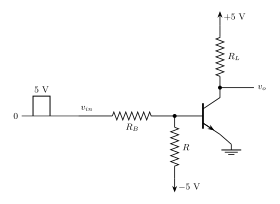
A circuit of a NOT gate is given in the figure below. Explain how you will determine the values of the resistances R_B, R and R_L.
What are the salient characteristics of ferromagnetic ? Explain how the Curie law of paramagnetism is modified to the Curie - Weiss law.
Which one of these mechanisms shows a negative dynamic resistance? Why?
Do these mechanisms have different temperature coefficients? Explain.
Discuss the different breakdown mechanisms for a reverse biased Zener diode.
Simplify the given Boolean expression and draw the corresponding logic circuit using NAND gates: Y = (\bar{A} + B + C) . (\bar{A} + \bar{B} + C)
A junction diode in series with a parallel combination of a large resistor and a capacitor acts as a linear detector of amplitude modulated waves. Explain the action.