101cse-2020-subject-05-001
Paper II15 Marks
Using the uncertainty principle \Delta x\Delta p \geq \hbar/2, estimate the ground state energy of a harmonic oscillator.
Search, filter, and study UPSC Civil Services & IFoS Physics past year questions with rigorous derivations, formulas, and step-by-step solutions.
Buy PYQ Solution Manual →
Using the uncertainty principle \Delta x\Delta p \geq \hbar/2, estimate the ground state energy of a harmonic oscillator.
Calculate the Hall coefficient of sodium based on the free electron model. Sodium has BCC structure and the side of the cube is 4.28\,\mathring{\mathrm{A}}.
(i) Draw a neat sketch of a finite rectangular potential barrier well of height U' and width L' that contains a particle whose energy E' is less than U'. Solve the Schr"{o}dinger equations of the particles outside the well.
(ii) Plot wave functions and probability densities |\psi|^2 of the particle for the first three states. Compare the results with that of a particle in a box of infinite potential (U = \infty).
Write the wave functions for a particle on both sides of a step potential, for E>V_0: V(x)=\begin{cases} V_0, & x>0\\ 0, & x<0 \end{cases}
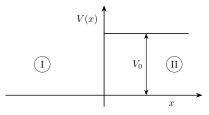
Interpret the results physically.
Draw a neat sketch showing potential wells and energy levels of the following :
(i) Harmonic oscillator
(ii) Hydrogen atom
(iii) Particle in a box
List the contrasting points and mention the variation of $E_n$' with n' of the above plots.
What is Normal Zeeman effect ? Give the classical interpretation of Normal Zeeman effect.
Write down the Hamiltonian operator for a linear harmonic oscillator. Show that the energy eigenvalue of the same can be given by E_n=\left(n+\frac{1}{2}\right)\hbar\omega_0 at energy state n with \omega_0 being the natural frequency of vibration of the linear oscillator. Prove that n=0 energy state has a wave function of typical Gaussian form.
Describe normal and anomalous Zeeman effect. Explain how it lifts the degeneracy in hydrogen atom.
Show that the phase velocity v_p for a particle with rest mass m_0 is always greater than the velocity of light and that v_p is a function of wavelength.
An electron and a photon each has a wavelength of 2~\text{\AA}. Calculate (i) their momenta and (ii) the ratio of their kinetic energies.
Estimate the size of hydrogen atom and the ground state energy from the uncertainty principle.
State and express mathematically the three uncertainty principles of Heisenberg. Highlight the physical significance of these principles in the development of Quantum Mechanics.
Define mathematically the Bohr radius of a hydrogen atom and show that the binding energy at state n of this atom can be given by E_n=-\frac{1}{2}\frac{Ze^2}{(a/Z)4n^2\pi\epsilon_0} where Z is the atomic number of H atom. Calculate the numerical values of a and E_1 of H atom.
Show that the mass and linear momentum of a quantum mechanical particle can be given by m=h/(\lambda v) and p=h/\lambda, respectively, where h, \lambda and v are Planck’s constant, wavelength, and velocity of the particle, respectively. Comment on the wave-particle duality from these relations.
$. Hence find the uncertainty product (\Delta x)(\Delta H).
How do you define density of states? Show that the density of states with wave vector less than \vec{k} in a three-dimensional cubic box of volume V can be given by D(\omega)=\frac{V}{2\pi^2}k^2\left(\frac{dk}{d\omega}\right) in the frequency spectrum between \omega and \omega+d\omega. Here, assume that the number of modes per unit range of k is L/(2\pi), L being the length of each side of the cubic box.
For a free quantum mechanical particle under the influence of a one-dimensional potential, show that the energy is quantized in discrete fashion. How do these energy values differ from those of a linear harmonic oscillator?
An electron is confined in the ground state of a one-dimensional harmonic oscillator such that \Delta x = 10^{-10}~\text{m}. Assuming \langle T \rangle = \langle V \rangle, find the energy in eV required to excite it to the first excited state.
Consider a particle whose wave function is given by \psi(x) = A e^{-\alpha x^2}.
(i) What is the value of A if this wave function is normalized?
(ii) Calculate the expectation value of x for this particle.
Define angular momentum of a particle and find out the three components of the angular momentum operator \hat{L} in Cartesian coordinates. Show that \hat{L}^2=-\hbar^2\left[r^2\nabla^2-\frac{\partial}{\partial r}\left(r^2\frac{\partial}{\partial r}\right)\right] Prove that the operator \hat{L}^2 can also be expressed as \hat{L}^2=-\hbar^2\left[\frac{1}{\sin\theta}\frac{\partial}{\partial\theta}\left(\sin\theta\frac{\partial}{\partial\theta}\right)+\frac{1}{\sin^2\theta}\frac{\partial^2}{\partial\phi^2}\right] in spherical polar coordinates (r,\theta,\phi).