81ifos-2021-subject-05-007
Paper II15 Marks
Find the eigenvalues and eigenstates of the spin operator \vec{S} of an electron in the direction of unit vector \vec{n}. Assume that \vec{n} lies in the xz-plane using spin matrices.
Search, filter, and study UPSC Civil Services & IFoS Physics past year questions with rigorous derivations, formulas, and step-by-step solutions.
Buy PYQ Solution Manual →
Find the eigenvalues and eigenstates of the spin operator \vec{S} of an electron in the direction of unit vector \vec{n}. Assume that \vec{n} lies in the xz-plane using spin matrices.
Find the uncertainty in the momentum of a particle when its position is determined within 0.02 cm. Find also the uncertainty in the velocity of an electron and \alpha-particle respectively when they are located within 15 \times 10^{-8}\,cm.
Use WKB method to estimate the energy levels of a one-dimensional harmonic oscillator.
A particle is moving in a one-dimensional box of width 50\,\mathring{\mathrm{A}} and infinite height. Calculate the probability of finding the particle within an interval of 15\,\mathring{\mathrm{A}} at the centres of the box when it is in its state of least energy.
Calculate the probability of finding a simple harmonic oscillator within the classical limits if the oscillator is in its normal state. Also show that if the oscillator is in its normal state, then the probability of finding the particle outside the classical limits is approximately 16\%.
(i) Derive the Schrodinger time-independent wave equation for matter waves. (ii) An electron is confined to move in a one-dimensional potential well of length 5\text{ \AA}. Find the quantized energy values for the three lowest energy states.
To illustrate the idea that the zero point energy gets larger by going from macroscopic to microscopic systems, calculate the zero point energy for a particle in an infinite potential well for the following three cases : (i) A 100\text{ g} ball confined on a 5\text{ m} long line. (ii) An oxygen atom confined to a 2 \times 10^{-10}\text{ m} lattice. (iii) An electron confined to a 10^{-10}\text{ m} atom.
What is Normal Zeeman effect ? Give the classical interpretation of Normal Zeeman effect.
(i) What do you mean by expectation value of a physical quantity ? How does it help to extract information from a wave function ? (ii) A particle limited to move along x-axis has the wave function \psi = ax between x = 0 and x = 1, \psi = 0 elsewhere. Find the probability that the particle can be found between x = 0\cdot 45 and x = 0\cdot 55. Find the expectation value <x> of the particles position x = 0 to x = 1.
What is Zeeman effect? Explain Zeeman effect on the basis of classical electron theory.
Calculate the Hall coefficient of sodium based on the free electron model. Sodium has BCC structure and the side of the cube is 4.28\,\mathring{\mathrm{A}}.
(i) State and explain position momentum uncertainty principle. Justify that this principle is not just a negative statement rather a useful tool, with one example. (ii) The lifetime of an excited state of an atom is about 10^{-8}\text{ sec.} Calculate the minimum uncertainty in the energy of the excited state.
A particle is described by the wave function \Psi(x)=\left(\frac{\pi}{2}\right)^{-1/4}e^{-ax^2/2}. Calculate \Delta x and \Delta p for the particle, and verify the uncertainty relation \Delta x\Delta p=\frac{\hbar}{2}.
Find the probability current density for the wave function \Psi(x,t)=\left[Ae^{ipx/\hbar}+Be^{-ipx/\hbar}\right]e^{-ip^2t/2m\hbar} Interpret the result physically.
Prove that Bohr hydrogen atom approaches classical conditions, when n becomes very large and small quantum jumps are involved.
Consider a Hermitian operator A with property A^3=1. Show that A=1.
A blue lamp emits light of mean wavelength of 4500\ \mathring{\mathrm{A}}. The rating of the lamp is 150 W and its 8% of the energy appears as light. How many photons are emitted per second by the lamp?
Write the wave functions for a particle on both sides of a step potential, for E>V_0: V(x)=\begin{cases} V_0, & x>0\\ 0, & x<0 \end{cases}
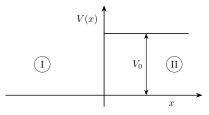
Interpret the results physically.
(i) Draw a neat sketch of a finite rectangular potential barrier well of height U' and width L' that contains a particle whose energy E' is less than U'. Solve the Schr"{o}dinger equations of the particles outside the well.
(ii) Plot wave functions and probability densities |\psi|^2 of the particle for the first three states. Compare the results with that of a particle in a box of infinite potential (U = \infty).
Using the uncertainty principle \Delta x\Delta p \geq \hbar/2, estimate the ground state energy of a harmonic oscillator.