Comment Done
Navigation
HomePYQs Question BankCSE Physics OptionalIFoS Physics OptionalBlog & InsightsCourses & ProgrammesMy Courses (Candidate Portal)
Account

PYQ Bank

340

Search, filter, and study UPSC Civil Services & IFoS Physics past year questions with rigorous derivations, formulas, and step-by-step solutions.

Buy PYQ Solution Manual →
PYQ Blueprint Art
/
20 questions visible on this page
Shortcuts: / filter, Esc reset
261cse-2007-subject-05-004
CSE 2007Paper II20 Marks

Determine the discrete energy levels and the corresponding eigenfunctions for a particle in an infinitely deep potential well inside a cube of dimension L, i.e., assume \begin{gathered} V(x,y,z) = 0 \quad \text{for } 0 < x < L;\\ 0 < y < L;\\ 0 < z < L = \infty \quad \text{elsewhere} \end{gathered}
Full Thread
262cse-2007-subject-05-006
CSE 2007Paper II20 Marks

(i) Define angular momentum, Express it in operator form and show that \vec{L} \times \vec{L} = i\hbar \vec{L} Explain the physical significance of this relation. (10) (ii) Let Y_{lm} be an eigenstate of L^2 and L_z with eigenvalues l(l + 1)\hbar^2 and m\hbar, respectively. Show that \phi = (L_x + i L_y) Y_{lm} is likewise an eigenstate of L^2 and L_z, and determine the eigenvalues. (10)

Full Thread
263cse-2007-subject-05-002
CSE 2007Paper II20 Marks

(i) State and explain Heisenberg's uncertainty principle. Experimental data reveal that no electron in an atom has energy greater than 4 MeV. Assuming that the radius of a nucleus is 10^{-14}\text{ m}, show using Heisenberg's uncertainty principle that an electron cannot exist inside the nucleus. (10) (ii) Calculate the de Broglie wavelength of thermal neutrons at 300 K. (10)

Full Thread
264cse-2006-subject-05-005
CSE 2006Paper II30 Marks

Distinguish between potential well and potential barrier. Given their illustrations. Considering one-dimensional potential step, prove that sum of the reflection and transmission coefficients is unity.

Full Thread
265cse-2006-subject-05-003
CSE 2006Paper II20 Marks

(i) Using Pauli matrices \sigma_x, \sigma_y and \sigma_z, show that \left(\vec{\sigma} \cdot \vec{r}\right) \left(\vec{\sigma} \cdot \vec{p}\right) = \vec{r} \cdot \vec{p} + i \vec{\sigma} \cdot \vec{L} \hfill 10 (ii) For the radiation of wavelength 6000~\text{\AA}, determine the wavelength separation between its two component lines which are observed in the normal Zeeman effect. The magnetic field used is \frac{\pi}{4}~\text{weber}/\text{m}^2 and the specific charge of the electron = 1.76 \times 10^{11}~\text{C}~\text{kg}^{-1}. \hfill 10

Full Thread
266cse-2006-subject-05-004
CSE 2006Paper II40 Marks

Explain how the problem of the hydrogen atom could be solved using Schrodinger equation. Also derive an expression for its energy eigenvalue and discuss the associated bound states of this case.

Full Thread
267cse-2006-subject-05-002
CSE 2006Paper II30 Marks

Prove that \frac{d}{dt}(x) = \frac{1}{m}(p_x) Define all the terms of this relation and give its physical interpretation.

Full Thread
268cse-2006-subject-05-001
CSE 2006Paper II20 Marks

(i) Calculate the de Broglie wavelength of a thermal neutron at 27~^\circ\text{C} temperature. \hfill 10 (ii) Considering one-dimensional case for free particle, show that the plane wave function is the eigenfunction of a linear momentum operator and kinetic energy operator. \hfill 10

Full Thread
269cse-2005-subject-05-003
CSE 2005Paper II30 Marks

Consider a particle of mass m in an infinite one dimensional potential well of width a. The particle is found in the state given by \psi (x) = c \left[ \sin \frac{\pi x}{a} + \frac{1}{2} \sin \frac{2 \pi x}{a} \right] (i) Calculate c. (ii) If a measurement of energy is made, what are the possible results and what are the probabilities for each one of them ?

Full Thread
270cse-2005-subject-05-002
CSE 2005Paper II30+30 Marks

Discuss WKB approximation and apply the same to determine the transition probability for leakage through a potential barrier.

Full Thread
271cse-2005-subject-05-005
CSE 2005Paper II10+10 Marks

(i) The ground state wavefunction of a linear simple harmonic oscillator is \psi = A \exp \left( - \frac{\alpha^2 x^2}{2} \right) Calculate the constant A and the average values of x^2 and x. Given that \int_0^\infty e^{-x^2} = \frac{\pi^{1/2}}{2} (ii) How can the pure rotation spectrum of \text{H}_2 molecule be observed ? If the bond length of \text{H}_2 molecule is 0 \cdot 07417 \text{ nm}, what would be the spacing of lines in its spectrum ?

Full Thread
272cse-2005-subject-05-001
CSE 2005Paper II10+10 Marks

(i) Write the commutation relations for the position variable x and the momentum components p_x, p_y and p_z. Explain the physical significance of these relations. (ii) Calculate the de Broglie wavelength of an electron moving with a kinetic energy of 1 MeV.

Full Thread
273cse-2005-subject-05-004
CSE 2005Paper II40 Marks

Set up the time-independent Schrodinger equation for an electron moving in Coulomb field, V(r) = \frac{Ze^2}{4 \pi \varepsilon_0 r}, in polar coordinates. Solve the radial equation to get the energy eigen values.

Full Thread
274cse-2004-subject-05-002
CSE 2004Paper II20 Marks

A hydrogen atom is in the following state : \Psi_{nlm} (r, 0) = (\sqrt{1/14}) [2\psi_{100}(r) - 3\psi_{200}(r) + \psi_{322}(r)] (i) What is the probability of finding the system in the state (200) ? (ii) What are \langle H \rangle and \langle L_z \rangle ?

Full Thread
275cse-2004-subject-05-001
CSE 2004Paper II20 Marks

Set up the time-independent Schrodinger equation for an electron moving in Coulomb field, V(r) = \frac{Ze^2}{4\pi\varepsilon_0 r} in polar coordinates. Solve the radial equation to get the energy eigen values.

Full Thread
276cse-2003-subject-05-003
CSE 2003Paper II15 Marks

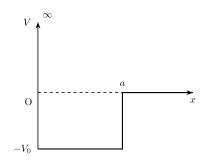
A particle of mass m, with energy E such that -V_0 < E < 0, is trapped in a potential wall as shown below :

Physics Diagram cse-q-5-159-fig-1

Write time independent Schrodinger equation in regions (i) 0 < x < a and (ii) x > a.

Full Thread
277cse-2003-subject-05-006
CSE 2003Paper II10+10 Marks

(i) Show that the radial probability density of the ground state of the hydrogen atom has a maximum at r = a. The ground state wave function of the hydrogen atom is given by \psi (r) = \frac{1}{\sqrt{\pi a^{3/2}}} e^{-r/a} where a is the Bohr radius. (ii) Calculate the Larmor frequency of a spin 1/2 particle in a magnetic field B.

Full Thread
278cse-2003-subject-05-005
CSE 2003Paper II15+5 Marks

= 0$. What is the significance of this commutation relation ? (ii) Show that the Pauli Matrices anti-commute.

Full Thread
279cse-2003-subject-05-001
CSE 2003Paper II10+10 Marks

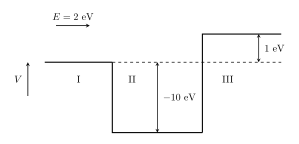
(i) Explain what do you understand by Heisenberg uncertainty principle. Using this principle, determine the energy of the ground state of a one dimensional simple harmonic oscillator. (ii) An electron having an energy 2 eV is travelling in the region where V(x) varies as shown below:

Physics Diagram cse-q-5-135-fig-1

Calculate the de Broglie wavelength of the electron in regions I, II and III.

Full Thread
280cse-2003-subject-05-007
CSE 2003Paper II30 Marks

Number at non-interacting electrons are confined in a cube of volume L^3. Obtain an expression for the Fermi energy.

Full Thread

Document & Diagram Scanner

Clean whiteboard & high-contrast scan with automatic image enhancement

Filter:
-- × -- pxCompressed: -- KB--% saved