Comment Done
Navigation
HomePYQs Question BankCSE Physics OptionalIFoS Physics OptionalBlog & InsightsCourses & ProgrammesMy Courses (Candidate Portal)
Account

PYQ Bank

340

Search, filter, and study UPSC Civil Services & IFoS Physics past year questions with rigorous derivations, formulas, and step-by-step solutions.

Buy PYQ Solution Manual →
PYQ Blueprint Art
/
20 questions visible on this page
Shortcuts: / filter, Esc reset
241ifos-2010-subject-05-002
IFOS 2010Paper II20 Marks

A stream of particles of mass M and energy E is directed from left to a one-dimensional potential well, as shown below :
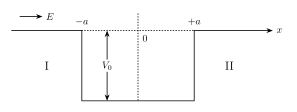
Physics Diagram ifos-q-5-026-fig-1

The potential is -V_0 in the region a \ge x \ge -a and zero elsewhere. Set up a time-independent Schrödinger equation and obtain an expression for the transmission ratio from region I to II. Discuss the result. Show that there is a finite reflection from such a potential well, which is a result of the wave nature of matter.

Full Thread
242ifos-2010-subject-05-004
IFOS 2010Paper II20 Marks

Set up the time-independent Schrödinger equation for an electron moving in a Coulomb field, V(r) = \frac{-ze^2}{4\pi\varepsilon_0 r}, in polar coordinates. Solve the radial equation to get the energy eigen values.

Full Thread
243cse-2009-subject-05-002
CSE 2009Paper II20 Marks

(i) Explain spin-orbit coupling of an atomic electron. (ii) Show that the 2p state in the H atom splits up into two substates due to spin-orbit coupling. (iii) Calculate the energy of separation in eV, resulting from the spin-orbit coupling when the magnetic field experienced by the electron is 0 \cdot 4 \text{ T}.

Full Thread
244cse-2009-subject-05-005
CSE 2009Paper II20 Marks

(i) Consider a positron in a box. If the energy released is 60 \text{ eV} when it jumps from the third excited state to the ground state, show that the width of the potential is nearly 0 \cdot 3 \text{ nm}. (ii) Prove that the most probable distance of an electron from the proton (in the hydrogen atom) is the Bohr radius of the hydrogen atom. Consider only the ground state.

Full Thread
245cse-2009-subject-05-004
CSE 2009Paper II20 Marks

(i) Consider a particle in a three-dimensional box. Derive an expression for g(E), the density of states. (ii) Show that \frac{g(p)}{g(E)} = \frac{dE}{dp} , where g(p) is the density of states in the momentum space. Deduce that g(p) is proportional to p^2 for a free non-relativistic particle.

Full Thread
246cse-2009-subject-05-003
CSE 2009Paper II20 Marks

Show that the time-dependent part of all the solutions of the Schrödinger equation in one-dimension has the structure \phi(t) = \exp (- i E t / h), provided the potential is not an explicit function of time.

Full Thread
247cse-2009-subject-05-007
CSE 2009Paper II20 Marks

Show that the Pauli Spin Matrices obey the following relations : (i) \text{Tr} (\sigma_x) = \text{Tr} (\sigma_y) (ii) \det (\sigma_y) = \det (\sigma_z) (iii) The eigenvalues of \sigma_z and \sigma_x are the same. (iv) Write down the y-component of the spin angular momentum matrix corresponding to an antineutrino.

Full Thread
248cse-2009-subject-05-001
CSE 2009Paper II20 Marks

(i) The quantum mechanical probability distribution function of an electron in the ground state of the hydrogen atom is P(r) = N r^2 \exp (-2br). Using the result \int_0^\infty P(r) \, dr = 1, deduce that N is proportional to b^3. (ii) Prove that the value of 40 \, k_B T at T = 300 \text{ K} is nearly 1 \text{ eV}. Hence determine the Fermi temperature of a metal whose Fermi energy is 9 \cdot 4 \text{ eV}. (iii) Show that the Fermi velocity is related to the Fermi energy of electrons through the relation \frac{v_F}{c} = 1 \cdot 98 \left( \frac{E_F}{1 \text{ MeV}} \right)^{1/2} .

Full Thread
249cse-2009-subject-05-006
CSE 2009Paper II10 Marks

Using dimensional analysis, explain why the angular momentum of a particle cannot be \hbar^2.

Full Thread
250cse-2008-subject-05-001
CSE 2008Paper II10 Marks

Explain normal and anomalous Zeeman effect. Obtain expression for Zeeman splitting of an alkali metal spectral line, and illustrate with an example.

Full Thread
251cse-2008-subject-05-006
CSE 2008Paper II10 Marks

An electron is in the spin state \chi = A \begin{pmatrix} 3i \\ 4 \end{pmatrix}. Determine the normalization constant A. Find the expectation value of the spin operator \hat{S}_x and also the uncertainty in the value of S_x in this state.

Full Thread
252cse-2008-subject-05-002
CSE 2008Paper II10 Marks

Show that for the one dimensional wave function \psi(x) = \begin{cases} \frac{1}{\sqrt{2a}} & , \quad |x| < a \\ 0 & , \quad |x| > a \end{cases} where a is a real constant, the rms uncertainty in momentum is infinite.

Full Thread
253cse-2008-subject-05-003
CSE 2008Paper II10 Marks

Write (do not derive) the formula for the energy levels of a particle in a three dimensional cubical box of side L. How many electrons can occupy the level having energy 66h^2/8mL^2 ?

Full Thread
254cse-2008-subject-05-007
CSE 2008Paper II20 Marks

$ and [\hat{L}_-, \hat{L}_z]. Show that \hat{L}_+ |l, m\rangle = \sqrt{l(l+1) - m(m+1)} |l, m+1\rangle, where |l, m\rangle is the state with definite values for L^2 and L_z.

Full Thread
255cse-2008-subject-05-004
CSE 2008Paper II30 Marks

The Hamiltonian of a particle moving along the x-axis is given by \hat{H} = -\alpha \frac{d^2}{dx^2} + 16\alpha \hat{x}^2, where \alpha is a real and positive constant having dimensions of energy. (i) If \psi(x) = A e^{-2x^2}, find the normalization constant A. Check whether \psi is an eigen function of \hat{H}. If yes, find the corresponding eigen value. (ii) Calculate the probability of finding the particle anywhere along the negative x-axis. (iii) Find the eigen value of \hat{H} corresponding to the eigen function \phi(x) = x\psi(x), where \psi(x) is the same as in part (i). (iv) Are the wave functions \psi(x) and \phi(x) orthogonal ?

Full Thread
256cse-2008-subject-05-005
CSE 2008Paper II30 Marks

Show that the probability of transmission across the step barrier represented by the potential V(x) = \begin{cases} 0 & \text{for } x < 0 \\ V_0 & \text{for } x > 0 \end{cases} is T = \frac{4 k_1 k_2}{(k_1 + k_2)^2}, where k_1 and k_2 are wave numbers in regions x < 0 and x > 0, respectively.

Full Thread
257cse-2008-subject-05-008
CSE 2008Paper II20 Marks

An electron is moving freely in a one-dimensional infinite potential box with walls at x = 0 and x = a. If the electron is initially in the ground state of the box and if suddenly the wall at x = a is moved x = 4a, calculate the probability of finding the particle in the ground state of the new box.

Full Thread
258cse-2007-subject-05-001
CSE 2007Paper II25 Marks

In the free electron theory of metals, a conductor is regarded as consisting of free electrons in a three-dimensional box. Using the results of (a), obtain an expression for the density of states,

Full Thread
259cse-2007-subject-05-005
CSE 2007Paper II20 Marks

A one-dimensional potential barrier is represented by the function V(x) = 0 \quad \text{for } x < 0 = V_0 \quad \text{for } x > 0 Where V_0 is positive. Find the transmission coefficient for particles of mass m incident from the left on the barrier.

Full Thread
260cse-2007-subject-05-003
CSE 2007Paper II40 Marks

Solve the Schrodinger equation for a linear harmonic oscillator. Obtain the eigenvalues and the corresponding eigenfunctions.

Full Thread

Document & Diagram Scanner

Clean whiteboard & high-contrast scan with automatic image enhancement

Filter:
-- × -- pxCompressed: -- KB--% saved