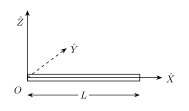
A rod of length L has non-uniform linear mass density (mass per unit length) \lambda, which varies as \lambda=\lambda_0\left(\dfrac{S}{L}\right); where \lambda_0 is a constant and S is the distance from the end marked `O' (as shown in the figure). Find the centre of mass of the rod.
(i) If a particle of mass m is in a central force field f(r)\hat{r}, then show that its path must be a plane curve, where \hat{r} is a unit vector in the direction of position vector \vec{r}.
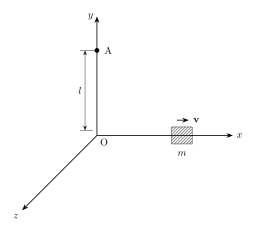
(ii) A block of mass m having negligible dimension is sliding freely in x-direction with velocity \vec{v}=v\hat{\imath} as shown in the diagram.
What is its angular momentum \vec{L}_O about origin O and its angular momentum \vec{L}_A about the point A on y-axis?
Two capillary tubes of lengths 2l and l with internal radii r and 2r respectively are connected in series. Water flows through them in streamline. If the pressure difference across the first capillary is P, find the pressure difference across the second one.
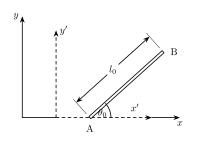
A rod of length l_0 is kept at rest in x'\,y' plane of its rest frame making an angle \theta_0 with x' axis. What is the length and orientation of the rod in a laboratory frame (x,y) in which the rod moves to the right with velocity v?
State the fundamental postulates of Einstein's special theory of relativity. Deduce Lorentz transformation equation and discuss how this accounts for the phenomenon of length contraction.
A ball moving with a speed of 9\ \mathrm{m/s} strikes an identical stationary ball such that after the collision the direction of each ball makes an angle 30^\circ with the original line of motion. Find the speed of the balls after the collision. Is the kinetic energy conserved in this collision?
Discuss the mechanics of a system of point particles with special emphasis on the conservation theorems. How can we extend the results to a system with continuous mass distribution ?
Describe Michelson-Morley experiment and show how the negative results obtained from this experiment were interpreted.
Prove that x^2+y^2+z^2=c^2t^2 is invariant under Lorentz transformation.
Show that the relativistic invariance laws of conservation of momentum lead to the concepts of variation of mass with velocity and mass energy equivalence.
(i) State and prove Hamilton's principle and use it to prove that the shortest distance between two points in space is a straight line joining them. (ii) Use Hamiltonian mechanics to find the differential equation for planetary motion, moving under force f(r) = -\frac{k}{r^2} and prove that the areal velocity is constant.
Express angular momentum in terms of kinetic, potential and total energy of a satellite of mass m in a circular orbit of radius r.
A bead slides on a wire in the shape of a cycloid described by the equations x = a (\theta - \sin \theta) y = a (1 + \cos \theta) \quad \text{with} \quad 0 \le \theta \le 2\pi. Find the Lagrangian and equation of motion.
State and explain Stokes' law. A drop of water of radius 0.01\ \mathrm{m} is falling through a medium whose density is 1.21\ \mathrm{kg/m^3} and \eta = 1.8 \times 10^{-5}\ \mathrm{N\,s/m^2}. Find the terminal velocity of the drop of water.
A diatomic molecule can be considered to be made up of two masses m_1 and m_2 separated by a fixed distance r. Derive a formula for the distance of centre of mass, C, from mass m_1. Also show that the moment of inertia about an axis through C and perpendicular to r is \mu r^2, where \mu=\dfrac{m_1m_2}{m_1+m_2}.
Define moment of inertia and explain its physical significance. Calculate the moment of inertia of an annular ring about an axis passing through its centre and perpendicular to its plane.
Calculate the percentage contraction in the length of a rod in a frame of reference, moving with velocity 0.8c in a direction What is the orientation of the rod in the moving frame of reference in case (ii)?
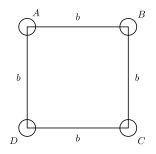
Four solid spheres A, B, C, and D each of mass m and radius a, are placed with their centres on the four corners of square of side b as shown in the figure below:
Calculate the moment of inertia of the system about one side of the square, Also, calculate the moment of inertia of the system about a diagonal of the square.
Using Euler's equations for a force free motion of a rigid body, show that the Kinetic energy remains constant throughout the motion of the rigid body.
Given a proton for which \beta=0.995 measured in the laboratory. What are the corresponding relativistic energy and momentum? Take, m_p=1\cdot67\times10^{-24}\,\mathrm{g}.