101cse-2019-subject-01-007
Paper I15 Marks
Search, filter, and study UPSC Civil Services & IFoS Physics past year questions with rigorous derivations, formulas, and step-by-step solutions.
Buy PYQ Solution Manual →
A three-particle system consists of masses \text{m}_i,\ i = 1, 2, 3 and their respective coordinates (\text{x}_i, \text{y}_i, \text{z}_i) : m_1 = 3m,\ (x_1, y_1, z_1) = (a, 0, a), m_2 = 4m,\ (x_2, y_2, z_2) = (a, a, -a), m_3 = 2m,\ (x_3, y_3, z_3) = (-a, a, 0), where m and a are positive constants. Calculate the inertia tensor of the system.
(i) What is central force? Give two examples of the central force.
(ii) Show that the angular momentum \vec{L} of the particle in a central force field is a constant of motion.
Two \beta-particles A and B emitted by a radioactive source R travel in opposite directions, each with a velocity of 0.9c with respect to the source. Find the velocity of B with respect to A (Here c is the velocity of light).
Show that the cross-section for elastic scattering of a point particle from an infinitely massive sphere of radius R is \dfrac{R^2}{4}. What is the inference of this result?
A mouse of mass m jumps on the outside edge of a freely turning ceiling fan of rotational inertia I and radius R. By what ratio does the angular velocity change ?
How fast and in what direction must galaxy A be moving if an absorption line found at wavelength 550\text{ nm} (green) for a stationary galaxy is shifted to 450\text{ nm} for galaxy A and how fast and in what direction is galaxy B moving if the same line is shifted to 700\text{ nm} for it ?
(i) Find the moments of inertia of rigid diatomic molecule about different axes of symmetry through the centre of mass.
(ii) A proton is 1837 times heavier than an electron. Find the centre of mass of hydrogen atom.
Consider a light beam passing through a horizontal column of water moving with a velocity 'v'. Determine the speed u of the light measured in the lab frame when the beam travels in the same direction as the flow of the water. (Speed of water = v (lab frame), and refractive index = n)
A particle of mass m rests on a smooth plane. The plane is then raised to an inclination angle \theta at a constant rate \alpha (\theta = 0 at t = 0), causing the particle to move down the plane, as shown in the figure below.
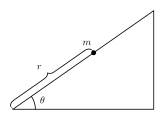
Write down the Lagrangian and determine the equations of motion. Solve the resulting equation for "r" to obtain the expression for r(t).
Where do you find the applications of gyroscope? A top of mass 0.200\ \mathrm{kg} is made up of a thin disc of radius 0.12\ \mathrm{m}. It is pierced in the centre and a pin of negligible mass is mounted normal to its plane. The pivot under the disc is 0.03\ \mathrm{m} long. The top is made to spin with its axis making an angle \theta = 20^\circ with the vertical and a precessional angular speed of 2\ \mathrm{rad/s}. Calculate the angular speed with which it spins.
Consider a homogeneous cube of total mass M and side a. Taking the origin at one corner of the cube and axes along the edges of the cube, construct the moment of inertia tensor. Calculate principal moment of inertia.
Show that the wave equation for the propagation of electromagnetic scalar potential \phi(x, y, z, t) \left[\nabla^2 - \frac{1}{c^2} \frac{\partial^2}{\partial t^2}\right] \phi(x, y, z, t) = 0 remains invariant under Lorentz transformation.
(i) If a particle of mass m is in a central force field f(r)\hat{r}, then show that its path must be a plane curve, where \hat{r} is a unit vector in the direction of position vector \vec{r}.
(ii) A block of mass m having negligible dimension is sliding freely in x-direction with velocity \vec{v}=v\hat{\imath} as shown in the diagram.
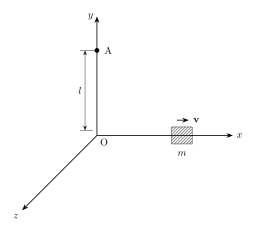
What is its angular momentum \vec{L}_O about origin O and its angular momentum \vec{L}_A about the point A on y-axis?
Use Gauss's theorem to calculate the gravitational potential due to a solid sphere at a point outside the sphere. Calculate the amount of work required to send a body of mass m from the Earth's surface to a height R/2, where R is the radius of the Earth.
Two capillary tubes of lengths 2l and l with internal radii r and 2r respectively are connected in series. Water flows through them in streamline. If the pressure difference across the first capillary is P, find the pressure difference across the second one.
Calculate the first relativistic correction to the kinetic energy of a particle with rest mass m_0 and speed v.
A particle moving in a central force field located at r=0, describes a spiral, r=e^{-\theta}. Find the force law.
A particle of mass m is constrained to move on a plane curve xy=c with c>0, under gravity, where y-axis is vertical. Construct the Lagrangian of the system and obtain the Euler-Lagrange equation of motion.