81ifos-2021-subject-01-002
Paper I15 Marks
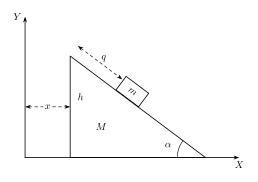
A block of mass m is sliding on a wedge of mass M as shown in the figure below. The wedge can slide on the horizontal table. Find the equation of motion.
Search, filter, and study UPSC Civil Services & IFoS Physics past year questions with rigorous derivations, formulas, and step-by-step solutions.
Buy PYQ Solution Manual →
A block of mass m is sliding on a wedge of mass M as shown in the figure below. The wedge can slide on the horizontal table. Find the equation of motion.
Obtain the Lorentz transformations for the components of momentum-energy four vector.
Two spaceships approach each other, each moving with the same speed as measured by a stationary observer on the Earth. Their relative speed is 0{\cdot}7c. Determine the velocity of each spaceship as measured by the stationary observer on the Earth.
A rod of length L_0 moves with speed v along the horizontal direction. The rod makes an angle \theta_0 with respect to the x'-axis. (i) Determine the length of the rod as measured by a stationary observer. (ii) Determine the angle \theta the rod makes with the x-axis. (v is comparable to c)
Obtain expressions for the moment of inertia of a solid cone about its \begin{qroman}
(i) Vertical axis and
(ii) axis passing through the vertex and parallel to its base.
Explain the rotation of a free rigid body and show that a rigid body rotating in any manner about a fixed point has two constants of motion, L^2 and T. Here \vec{L} is angular momentum and T is kinetic energy.
A rocket of mass m_1 + m_2 is launched with a velocity whose horizontal and vertical components are u_x and u_y. At the highest point in its path, the rocket explodes into two parts of masses m_1 and m_2 that separate in a horizontal direction in the original plane of motion. Show that the fragments strike the ground at a distance apart given by D = \frac{u_y}{g} \sqrt{\frac{2(m_1 + m_2)K}{m_1 m_2}} where K is the kinetic energy produced by the explosion. (Neglect air resistance, the mass of explosive, any spinning motion of the fragments and assume that g is constant)
Suppose the position of a particle of mass m on the xy-plane is \bar{r} = (x, y, z) = (r \cos\phi, r \sin\phi, 0) Here r and \phi are functions of time t. Find l_z, the z-component of \vec{l}, where \vec{l} is the angular momentum of the particle. Further, show that the areal velocity is equal to the angular momentum divided by 2m. Is areal velocity constant?
A rocket starts vertically upwards with speed v_0. Then define its speed v at a height h in terms of v_0, h, R (radius of Earth) and g (acceleration due to gravity on Earth's surface). Also calculate the maximum height attained by a rocket fired with a speed of 90% of the escape velocity.
The moment of inertia of the CO molecule is 1\cdot 46 \times 10^{-46}\text{ kg-m}^2. Calculate the energy (in eV), and the angular velocity in the lowest rotational energy level of the CO molecule.
A rubber cord 1\ \mathrm{mm} in diameter and 1\ \mathrm{m} long is fixed at one end and a weight of 1\ \mathrm{kg} is attached to the other end. If the Young's modulus of rubber is 0.05 \times 10^{11}\ \mathrm{dynes\,cm^{-2}}, then find the period of the vertical oscillations of the weight.
What do you understand by length contraction? Calculate the percentage length contraction of a rod moving with a velocity 0.8c in a direction at 60^\circ with respect to its own length.
A shaft of diameter 8\,\mathrm{cm} and length 5\,\mathrm{m} is transmitting power of 8\,\mathrm{kW} at 300 revolutions per minute. If the coefficient of rigidity of the material of the shaft be 8 \times 10^{11}\,\mathrm{dynes/cm^2}, then calculate the relative shift between the ends of the shaft.
(i) Explain Coriolis force. Compare the qualitative effects of the Coriolis forces in the two geographical hemispheres of the Earth for rivers flowing east. (ii) With schematic, explain Foucault's pendulum.
Derive Euler-Lagrange equations of motion from Hamilton's principle for any bilateral holonomic system having no non-potential forces and n degree of freedom. Can it be applied to non-holonomic systems?
Derive the relativistic expression for kinetic energy by considering mass variation with velocity. Hence, establish the relation between momentum (p) and energy (E) for a relativistic particle; \frac{dE}{dp}=v.
Determine the location of the centre of mass of a uniform solid hemisphere of radius R and mass M from the centre of its base.
Describe Michelson-Morley experiment with the help of a diagram. Discuss why it is considered as the 'most famous failed experiment'.
A particle moves in an elliptical orbit in an inverse-square-law central force field. If the ratio of the maximum angular velocity to the minimum angular velocity of the particle in the orbit is n, then show that the eccentricity of the orbit is \varepsilon = \frac{\sqrt{n} - 1}{\sqrt{n} + 1}.
Where do you find the applications of gyroscope? A top of mass 0.200\ \mathrm{kg} is made up of a thin disc of radius 0.12\ \mathrm{m}. It is pierced in the centre and a pin of negligible mass is mounted normal to its plane. The pivot under the disc is 0.03\ \mathrm{m} long. The top is made to spin with its axis making an angle \theta = 20^\circ with the vertical and a precessional angular speed of 2\ \mathrm{rad/s}. Calculate the angular speed with which it spins.