Consider the motion of a particle of mass m in central force field \text{f(r)} = -\,\text{k}/\text{r}^2, where k is a constant and r is the distance from the force centre to the particle. Show that for the given system the vector \vec{\text{A}} = \vec{\text{p}} \times \vec{\text{L}} - \text{mk} \, \frac{\vec{\text{r}}}{\text{r}} is conserved. Using this vector and the fact that \vec{\text{A}} \cdot \vec{\text{L}} = 0, derive the orbit equation for the particle.
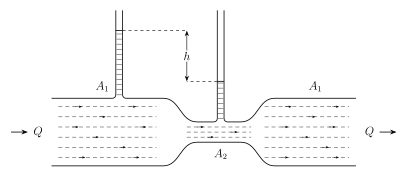
Consider the diagram below with a water flow rate Q. Derive the expression for Q in terms of the difference in the manometer heights h and the cross-section areas A_1 and A_2:
Show that for very small velocity, the equation for kinetic energy, K=\Delta mc^2 becomes K=\dfrac{1}{2}m_0v^2, where notations have their usual meanings.
Two spaceships approach each other, both moving with same speed as measured by a stationary observer on the Earth. Their relative speed is 0.7c. Determine the velocity of each spaceship as measured by the stationary observer on the Earth.
A particle P of mass m_1 collides with another particle Q of mass m_2 at rest. The particles P and Q travel at angles \theta and \phi, respectively, with respect to the initial direction of P. Derive the expression for the maximum value of \theta.
During take-off, an aircraft accelerates horizontally in a straight line at a rate A. A small bob of mass m is suspended on a string attached to the roof of the cabin, and a hydrogen balloon (total mass m) is tethered to the floor by a string. For each, determine the tension in the string and the equilibrium angle \theta between string and vertical. Draw a neat diagram to explain your answer.
A body of mass m at rest splits into two masses m_1 and m_2 by an explosion. After the split the bodies move with a total kinetic energy T in opposite direction. Show that their relative speed is \sqrt{\frac{2Tm}{m_1m_2}}.
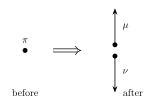
A pion at rest decays into a muon and a neutrino.
(i) Find the energy of the outgoing muon in terms of the two masses m_\pi and m_\mu (assuming m_\nu = 0). (ii) Find the velocity of muon.
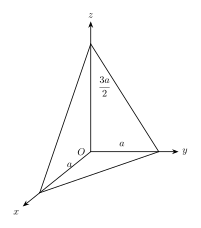
A homogeneous right triangular pyramid with the base side a and height \frac{3a}{2} is shown below. Obtain the moment of inertia tensor of the pyramid:
A rigid body is rotating under the influence of an external torque (N) acting on it. If T is the kinetic energy and \omega is the angular velocity, show that \dfrac{dT}{dt} = N \cdot \omega in the principal axes system.
An observer detects two explosions, one that occurs near him at a certain time and another that occurs 2\,\mathrm{ms} later 100\,\mathrm{km} away. Another observer finds that the two explosions occur at the same place. What time interval separates the explosions to the second observer?
Obtain the Lorentz transformations for the components of momentum-energy four vector.
A particle moving in a central force field describes the path r=ke^{\alpha\theta}, where k and \alpha are constants. If the mass of the particle is m, find the law of force.
The radius of the Earth is 6.4 \times 10^{6}\ \mathrm{m}, its mean density is 5.5 \times 10^{3}\ \mathrm{kg/m^{3}} and the universal gravitational constant is 6.66 \times 10^{-1}\ \mathrm{Nm^{2}/kg^{2}}. Calculate the gravitational potential on the surface of the Earth.
An electron is moving under the influence of a point nucleus of atomic number Z. Show that the orbit of the electron is an ellipse.
A comet of mass m moves towards the Sun with initial velocity v_0. The mass of the sun is M and its radius is R. Find the total cross-section \sigma for striking the Sun. Take the Sun to be at rest and ignore all other bodies.
A capillary tube having 1.0\,\mathrm{mm} diameter, 20\,\mathrm{cm} in length is fitted horizontally to a vessel in which alcohol is kept fully up to the neck. Density of alcohol is 8 \times 10^{2}\,\mathrm{kg/m^3}. The depth of the centre of the capillary tube below the surface of alcohol is 40\,\mathrm{cm}. Find the amount of alcohol that will flow out of the capillary tube in 10 minutes. Coefficient of viscosity of alcohol is 0.0012\,\mathrm{N\,s/m^2}.
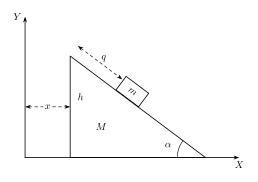
A block of mass m is sliding on a wedge of mass M as shown in the figure below. The wedge can slide on the horizontal table. Find the equation of motion.
On a space-time diagram after the Lorentz transformation with given v we get new tilted axis ct' and x'. For a point on the ct' axis which is at the (geometrical) distance \delta on the diagram measured from the origin, find the values of t' and t.
(i) Define the angular velocity \omega of a rigid body rotating about some axis.
(ii) Then derive the relation \vec{v} = \vec{\omega} \times \vec{r} for the velocity of a point in the body with position vector \vec{r} relative to an origin on the axis. Draw a diagram explaining all the vectors.