41cse-2023-subject-01-004
Paper I10 Marks
What are the consequences of Lorentz transformations on length and time when observed from a frame moving at relativistic velocities ?
Search, filter, and study UPSC Civil Services & IFoS Physics past year questions with rigorous derivations, formulas, and step-by-step solutions.
Buy PYQ Solution Manual →
What are the consequences of Lorentz transformations on length and time when observed from a frame moving at relativistic velocities ?
Calculate the inertia tensor for a rigid body consisting of three particles of masses 3 gm, 1 gm, 2 gm located at (1, -1, 2)\text{ cm}, (1, 0, 2)\text{ cm}, (-2, 1, 0)\text{ cm} respectively.
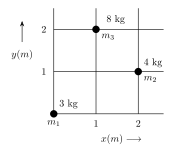
What are the coordinates of the centre of mass of the system of masses shown in the figure?
A force \vec{F} is given by \vec{F} = x^2 y \hat{x} + z y^2 \hat{y} + x z^2 \hat{z}. Determine whether or not the force is conservative.
A hoop is rolling down on an inclined plane without slipping. Find its velocity at the bottom of the inclined plane.
(i) The quantities of rotatory motion are analogous to those of translatory motion. Write the corresponding equations of translatory and rotatory motion. (ii) Describe the theorems of perpendicular and parallel axes in case of a plane lamina.
A particle of mass m moves under the action of a central force whose potential is V(r) = Kmr^4 (K > 0). Calculate the kinetic energy for which the orbit will be circle of radius R, about the origin.
Calculate the gravitational self-energy of the Earth. Given : Mass of Earth M_e = 6 \times 10^{24}\text{ kg} and the Radius of Earth R_e = 6\cdot4 \times 10^6\text{ m}
Define streamline flow of a fluid. Using the equation of continuity for an isotropic fluid, find different components of total energy per unit volume.
Why can Electron-Positron pair production through a high energy photon not take place in vacuum?
Calculate the velocity of a particle having kinetic energy four times the rest mass energy.
Calculate the inertia tensor for a rigid body consisting of three particles of masses 3\text{ gm}, 1\text{ gm}, 2\text{ gm} located at (1, -1, 2)\text{ cm}, (1, 0, 2)\text{ cm}, (-2, 1, 0)\text{ cm} respectively.
A particle of mass m moves under the action of a central force whose potential is V(r) = Kmr^4 (K > 0). Calculate the kinetic energy for which the orbit will be circle of radius R, about the origin.
A small block of mass m slides without friction down a wedge-shaped block of mass M and opening angle \alpha as depicted below.
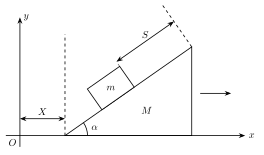
The wedge-shaped block itself slides along the horizontal frictionless floor along the +\text{ve x-direction}. Find the horizontal acceleration \ddot{\text{X}} = \text{d}^2\text{X}/\text{dt}^2 of the wedge-shaped block by the Lagrangian method and using the displacements \text{X} and \text{S} of the blocks as generalized coordinates.
Consider a particle of mass m moving in a potential field of the form \text{V}(\vec{\text{r}}) = \text{V}_0(\text{x}^2 + \text{y}^2), where \text{V}_0 is a constant. What are the conserved physical quantities for the particle ?
Consider the motion of a particle of mass m in central force field \text{f(r)} = -\,\text{k}/\text{r}^2, where k is a constant and r is the distance from the force centre to the particle. Show that for the given system the vector \vec{\text{A}} = \vec{\text{p}} \times \vec{\text{L}} - \text{mk} \, \frac{\vec{\text{r}}}{\text{r}} is conserved. Using this vector and the fact that \vec{\text{A}} \cdot \vec{\text{L}} = 0, derive the orbit equation for the particle.
Define moment of inertia and radius of gyration of a body of mass M rotating about an axis. State and prove Parallel Axis theorem on moment of inertia.
A particle P of mass m_1 collides with another particle Q of mass m_2 at rest. The particles P and Q travel at angles \theta and \phi, respectively, with respect to the initial direction of P. Derive the expression for the maximum value of \theta.
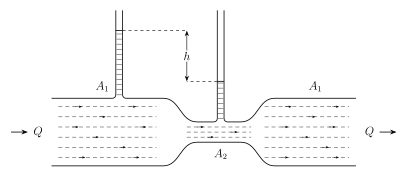
Consider the diagram below with a water flow rate Q. Derive the expression for Q in terms of the difference in the manometer heights h and the cross-section areas A_1 and A_2:
Consider the force-free motion of a symmetrical rigid body with z-axis as its axis of symmetry. Write down Euler's equations. Integrate them and obtain the solutions. On the basis of the obtained solutions show that the total angular velocity \vec{\omega} of such a rigid body is constant in magnitude and precesses about the z-axis with a constant frequency, say \Omega. Determine \Omega.