Explain the Poiseuille's equation for the rate of flow of a liquid through a capillary tube. From this, show that if two capillary tubes of radii r_1 and r_2 having lengths l_1 and l_2, respectively, are connected in series, the rate of flow of the liquid is given by Q = \frac{\pi P}{8 \eta} \left( \frac{l_1}{r_1^4} + \frac{l_2}{r_2^4} \right)^{-1} where P is the pressure across the arrangement and \eta is the coefficient of viscosity of the liquid.
Write down the expression for kinetic energy of a relativistic particle with rest mass m_0, moving with a speed v. (i) Show that the kinetic energy reduces to \frac{1}{2} m_0 v^2 in the non-relativistic limit. (ii) Find the first relativistic correction to the non-relativistic kinetic energy.
Construct the Lagrangian of a simple pendulum whose string is replaced by a spring with spring constant k and rest length l_0 oscillating in a vertical x - y plane. Find the equations of motion.
The Lagrangian of a system is given by L (\vec{r}, \vec{v}) = \frac{1}{2} m (\vec{v} + \vec{a})^2 + \vec{b} \cdot \vec{v} - \vec{c} \cdot \vec{r} where, \vec{a}, \vec{b} and \vec{c} are constant vectors. Construct the Hamiltonian of the system and find the canonical equations of motion.
Find the equation of orbit for a particle of mass m, moving in the influence of central force F(r) in terms of u \left(\equiv \frac{1}{r}\right).
State and explain the Hooke's law of elasticity. Briefly discuss the features of stress-strain diagram for the behaviour of a wire undergoing increasing stress.
The moment of inertia tensor of a cube of mass M and side a is given by the matrix I = \frac{M a^2}{12} \begin{bmatrix} 8 & -3 & -3 \\ -3 & 8 & -3 \\ -3 & -3 & 8 \end{bmatrix}. Calculate the principal moments of inertia of the cube.
Consider two inertial frames S and S'. S is at rest and S' is moving along x - x' direction with constant speed v. (i) Find how different components of momentum four-vector in S and S' frames are related. (ii) Show that p^\mu p_\mu is Lorentz invariant.
Briefly discuss the Kepler's laws of planetary motion.
Two satellites A and B of same mass are orbiting the Earth at altitudes R and 5R, respectively, where R is the radius of the Earth. Assuming their orbits to be circular, calculate the ratios of their kinetic and potential energies.
A charged \pi-meson with rest mass of 273 m_e at rest decays into a neutrino and a \mu-meson of rest mass 207 m_e. Find the kinetic energy of the \mu-meson and the energy of the neutrino. (m_e is the rest mass of the electron)
A galaxy in the constellation Ursa Major is receding from the Earth at 15000\text{ km/s}. If one of the characteristic wavelengths of light emitted by the galaxy is 550\text{ nm}, what is the corresponding wavelength measured by astronomers on the Earth?
Show that the angular momentum of a rigid body consisting of n particles of masses m_i, i = 1, 2, 3, \dots, n, rotating with an instantaneous angular velocity \mathbf{\omega} about an axis passing through the origin O of the coordinate system OXYZ is given by \mathbf{L} = \mathbf{I} \cdot \mathbf{\omega}, where \mathbf{I} is known as the inertia tensor.
Show that the escape velocity V_e on the surface of the Earth is given by V_e = \sqrt{2gR}, where g = 9.8\text{ m/s}^2 and R is the radius of the Earth.
Define generalized coordinates. How many generalized coordinates are required to describe the dynamics of (i) a free rigid body in 3 dimension ? (ii) a solid cylinder rolling in an inclined plane without slipping ?
Show that the kinetic energy of a system of n particles is given by T = \frac{1}{2} M V_{\text{cm}}^2 + \frac{1}{2} \sum_{i=1}^n m_i {V'_i}^2 where M is the total mass, V_{\text{cm}} is the velocity of the centre of mass, V'_i is the velocity of the particles about the centre of mass and m_i is the mass of the i\text{th} particle.
Consider three inertial frames of reference O, O' and O''. Let O' move with a velocity V with respect to O and O'' move with a velocity V' with respect to O'. Both velocities are in the same direction. Write down the transformation equations relating x, y, z, t with x', y', z', t' and also those relating x', y', z', t' with x'', y'', z'', t''. Hence obtain the relations between x, y, z, t and x'', y'', z'', t''. (The direction of velocity is chosen along the x-axis as per convention)
(i) Prove that the separation of two colliding particles is same, when observed in centre of mass and laboratory systems. (ii) Determine the kinetic energy of a thin disc of mass 0\cdot5\text{ kg} and radius 0\cdot2\text{ m} rotating with 100 rotations per second around the axis passing through its centre and perpendicular to its plane.
Calculate the inertia tensor for a rigid body consisting of three particles of masses 3\text{ gm}, 1\text{ gm}, 2\text{ gm} located at (1, -1, 2)\text{ cm}, (1, 0, 2)\text{ cm}, (-2, 1, 0)\text{ cm} respectively.
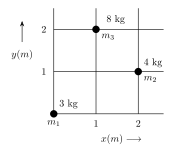
What are the coordinates of the centre of mass of the system of masses shown in the figure?