181ifos-2013-subject-01-002
Paper I8 Marks
Obtain an expression for the angular speed of the Earth at which Coriolis force makes objects fly from its surface.
Search, filter, and study UPSC Civil Services & IFoS Physics past year questions with rigorous derivations, formulas, and step-by-step solutions.
Buy PYQ Solution Manual →
Obtain an expression for the angular speed of the Earth at which Coriolis force makes objects fly from its surface.
A particle of rest mass M=4\times10^{-27}\ \mathrm{kg}, disintegrates into two particles of rest masses M_1=3\times10^{-27}\ \mathrm{kg} and M_2=1\times10^{-27}\ \mathrm{kg}. Show that the energies E_1 and E_2 of these two parts after disintegration satisfy the condition E_1=3E_2 while moving in opposite directions with equal linear momenta. Give necessary mathematical derivation.
Show that the operator \left(\nabla^2-\frac{1}{c^2}\frac{\partial^2}{\partial t^2}\right) is invariant under Lorentz transformations.
A particle describes a circular orbit under the influence of an attractive central force directed towards a point on the circle. Show that the force varies as the inverse fifth power of distance.
A satellite revolves in a circular orbit around the Earth at a certain height above it. Calculate the time period of revolution of the satellite, if the radius of the Earth is significantly higher than the height at which the satellite revolves.
If the forces acting on a particle are conservative, show that the total energy of the particle which is the sum of the kinetic and potential energies is conserved.
Prove that as a result of an elastic collision of two particles under non-relativistic regime with equal masses, the scattering angle will be 90^\circ. Illustrate your answer with a vector diagram.
Show that a particle of rest mass m_0, total energy E and linear momentum \vec{p} satisfies the relation E^2=c^2p^2+m_0^2c^4 where c is the velocity of light in free space.
Calculate the horizontal component of the Coriolis force acting on a body of mass 0.1\ \mathrm{kg} moving northward with a horizontal velocity of 100\ \mathrm{ms^{-1}} at 30^{\circ}\mathrm{N} latitude on the Earth.
Suppose that an S'-frame is rotating with respect to a fixed frame having the same origin. Assume that the angular velocity \vec{\omega} of the S'-frame is given by \vec{\omega}=2t\hat{\imath}-t^{2}\hat{\jmath}+(2t+4)\hat{k} where t is time and the position vector \vec{r} of a typical particle at time t as assumed in S'-frame is given by \vec{r}=(t^{2}+1)\hat{\imath}-6t\hat{\jmath}+4t^{3}\hat{k}. Calculate the Coriolis acceleration at t=1 second.
Show that the kinetic energy and angular momentum of torque free motion of a rigid body is constant.
Derive the relativistic length contraction using Lorentz transformation.
State Hamilton's principle for the motion of a monogenic system. Use the calculus of variation to deduce Lagrange's equation that follows from Hamilton's principle. Explain carefully all the terms used in the derivation.
Consider a uniform half-sphere of radius R and mass M. The half-sphere is supported by a frictionless horizontal plane as shown in the figure. The half-sphere lies in the region z<0.
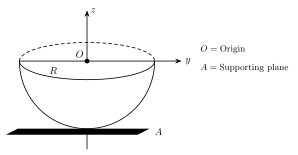
Find the centre of mass of the half-sphere.
Express Lagrange's equation of motion for the cyclic coordinate q_j and show that the result leads to the general conservation theorem for the generalized momentum coordinates.
A projectile of mass M explodes, while in flight, into three fragments. One fragment of mass m_1=M/2 travels in the original direction of the projectile. Another fragment of mass m_2=M/6 travels in the opposite direction and the third fragment of mass m_3=M/3 comes to rest. The energy E, released in the explosion, is 5 times the kinetic energy of the projectile at explosion. What are the velocities of the fragments?
A particle is moving in a central force field on an orbit given by r = ke^{\alpha\theta}, where k and \alpha are positive constants, r is the radial distance and \theta is the polar angle.
(i) Find the force law for the central force field.
(ii) Find \theta(t).
(iii) Find the total energy.
Define a conservative field. Determine if the field given below is conservative in nature: \vec{E}=c\left[y^2\hat{i}+(2xy+z^2)\hat{j}+2yz\hat{k}\right]\,\mathrm{V/m} where c is a constant.
Using D'Alembert's principle, show that the following relation can be obtained for a system of particles under generalized coordinates \sum_i \vec{F}_i \cdot \delta \vec{r}_i = \sum_j Q_j \delta q_j with Q_j = \sum_i \vec{F}_i \cdot \frac{\partial \vec{r}_i}{\partial q_j}. What is the significance of Q_j ?
Two identical relativistic particles of rest mass m and kinetic energy T collide head-on. What is the relative kinetic energy, i.e., the kinetic energy T' of one in the rest frame of the other?