41ifos-2024-subject-03-004
Paper I10 Marks
Current 'I' is passing through an infinite solenoid of radius R, with n turns per unit length. Find out the vector potential (i) inside the solenoid (ii) outside the solenoid.
Search, filter, and study UPSC Civil Services & IFoS Physics past year questions with rigorous derivations, formulas, and step-by-step solutions.
Buy PYQ Solution Manual →
Current 'I' is passing through an infinite solenoid of radius R, with n turns per unit length. Find out the vector potential (i) inside the solenoid (ii) outside the solenoid.
An AC circuit consists of inductance of self-induction 'L', a capacitor of capacitance 'C' and a resistor of resistance 'R' in series. Calculate the impedance 'Z' of the circuit. Obtain resonance condition and define quality factor.
Obtain an expression for Poisson's and Laplace's equations in electrostatics.
State Biot--Savart law and write its mathematical form. In case of distributed current sources, write this expression for line current, surface current and volume current.
Obtain the general boundary conditions for fields E, B, D and H at a boundary between two different media carrying charge density \sigma or a current density K.
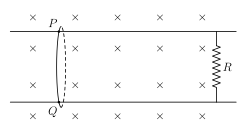
Consider a situation shown in the figure below. The wire PQ has mass m, resistance r and can slide on the smooth, horizontal parallel rails separated by a distance l. The resistance of rails is negligible. A uniform magnetic field B exists in the rectangular region and a resistance R connects the rails outside the field region. At t = 0, the wire PQ is pushed towards right with a speed V_0. Find (i) the current in the loop at an instant when the speed of the wire PQ is V and (ii) the acceleration of the wire at this instant :
Consider a uniformly magnetized sphere of radius a and magnetization \vec{M} = M_0 \hat{z} surrounded by a vacuum region. Obtain an expression for scalar magnetic potential for r < a.
Using Maxwell's equations, obtain Poisson's equation and Laplace's equation. The region -\frac{\pi}{2} < \frac{z}{z_0} < \frac{\pi}{2} has a charge density \rho = 10^{-8} \cos \left( \frac{z}{z_0} \right) (\text{C/m}^3). Elsewhere the charge density is zero. Find the electric potential V and electric field E from the Poisson's equation.
The magnitude of the average electric field normally present in the Earth's atmosphere just above the surface of the Earth is about 150\text{ N/C}, directed radially inward, toward the centre of the Earth. What is the total net surface charge carried by the Earth? Assume the Earth to be a conductor. (The radius of the Earth is 6.37 \times 10^6\text{ m})
Define electromagnetic field strength tensor F_{\mu\nu}. Express it in terms of components of electric and magnetic fields.
A spherical shell of radius R, carrying a uniform surface charge \sigma, is set spinning at angular velocity \omega about its axis. Find the vector potential it produces at point \vec{r}.
The wire AB shown in the figure below has mass m, resistance r and it can slide on the smooth horizontal parallel rails separated by a distance l. A uniform magnetic field B exists in the rectangular region and a resistance R connects the rails outside the field region. At t = 0, the wire AB is pushed towards right with a speed v_0.
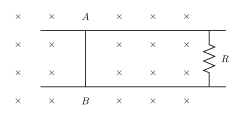
Find out the current in the loop at an instant when the speed of the wire is v. Find out the velocity v as a function of x. (Assume that the resistance of the rails is negligible)
What is Lenz's law? Is Lenz's law the same as Faraday's law? What happens if Lenz's law is reversed? Explain.
Explain Ampere's circuital law of magnetic field. What modifications Maxwell made in this equation to derive Maxwell's fourth equation?
An infinitely long coaxial cylinder structure has an inner conductor of radius a and an outer conductor of radius b. The inner conductor is attached to V_0, while the outer one is grounded. Calculate the field \vec{E} in between a and b.
If the electrostatic potential in spherical polar coordinate is \phi(r) = \phi_0 e^{-r/r_0} where \phi_0 and r_0 are constants, what will be the charge density at a distance r = r_0?
Two charges Q_1 = 3\text{ nC} and Q_2 = 4\text{ nC} are placed at the cartesian points (0, 2, 2)\text{ m} and (0, -2, 4)\text{ m}, respectively. The z = 0 plane is connected to the ground. Calculate the electric potential and the electric field at the point (3, 2, 4)\text{ m} using the method of images.
Show that Continuity equation is embedded in Maxwell's equations.
A circular ring of radius R lying on the x-y plane and centred at the origin, carries a uniform line charge \lambda. Find the first three terms (monopole, dipole and quadrupole) of the multipole expansion of potential V(r, \theta).
A neutral atom consists of a point nucleus +q surrounded by a uniformly charged spherical cloud (-q) of radius r. Show that when such an atom is placed in a weak external electric field \vec{E}, the atomic polarizability of the atom is proportional to the volume of the sphere.