Consider a point charge of 5\text{ nC} placed at a distance of 1\text{ m} from a perfect conducting plane (z = 0) of infinite extent. Find the electric field at a point (2, 2, 0)\text{ m} and show that it is normal to the plane.
Consider a conducting sphere of radius ‘a’ in a uniform electric field \vec{E}. Find the induced surface charge density on the sphere and determine the electric field \vec{E} at a point P characterized by radius vector \vec{r}.
Assume the Sun to be a black body at temperature 5800\text{ K}. Use Stefan's law to calculate :
(i) The total energy emitted by the Sun per second, and
(ii) The energy reaching the top of the Earth's atmosphere. Given : \sigma = 5\cdot 672 \times 10^{-8}\text{ SI units}, Radius of the Sun = 7 \times 10^8\text{ m}, The distance of the Earth's atmosphere from the Sun = 1\cdot 5 \times 10^{11}\text{ m}.
A certain linear, homogeneous, isotropic, dielectric material has a relative permittivity, \varepsilon_{\text{r}} = 1\cdot 8. If potential \text{V} = -4000\text{y} volts in the material, then find :
(i) The electric flux density \text{D}, and
(ii) The polarisation \text{P}. Take vacuum permittivity \varepsilon_0 = 8\cdot 85 \times 10^{-12}\text{ farad/m}.
Deduce Fresnel's law for the propagation of plane electromagnetic waves through an anisotropic dielectric medium.
(i) What is the method of images ? What are the conditions which must be satisfied while applying the method of images to deal with electrostatic problems ?
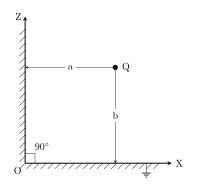
(ii) A point charge \text{Q} is located at the point (\text{a}, 0, \text{b}) between two semi-infinite conducting planes intersecting at right angles as shown in the figure. Using the method of images, determine the potential at point \text{P}(\text{x}, \text{y}, \text{z}) in the region \text{z} \ge 0 and \text{x} \ge 0 and the force on \text{Q}.
Show that the electromagnetic wave equation is invariant under Lorentz transformations.
(i) Show that the vector potential \vec{\text{A}} at the position defined by the vector \vec{\text{r}} in a uniform electric and magnetic field is \vec{\text{A}} = \frac{1}{2}(\vec{\text{B}} \times \vec{\text{r}}).
(ii) Find out the divergence and curl of the vector potential \vec{\text{A}}.
Derive the Planck's radiation law for blackbody radiation using the Bose-Einstein distribution function. Explain how results from quantum statistics differ from classical results derived from the Rayleigh-Jeans law.
Find the magnetic field strength (H) at the centre of a square current loop of side L.
In spherical coordinates, V = -25\text{ V} on a conductor at r = 2\text{ cm} and V = 150\text{ V} on another conductor at r = 35\text{ cm}. The space between the conductors is a dielectric for which \varepsilon_r = 3.12. Find the surface charge densities on the conductors.
Distinguish between self-inductance and mutual inductance. Calculate the self-inductance of a solenoid of length 'l', area of cross-section 'A' having N turns.
Briefly explain electronic, ionic and orientational polarisation. The polarisability of ammonia molecule is found to be 2.42 \times 10^{-39}\text{ C}^2\text{ m/N} and 1.74 \times 10^{-39}\text{ C}^2\text{ m/N} at 309\text{ K} and 448\text{ K} respectively. Calculate the orientation polarisability for each temperature.
An AC circuit consists of inductance of self-induction 'L', a capacitor of capacitance 'C' and a resistor of resistance 'R' in series. Calculate the impedance 'Z' of the circuit. Obtain resonance condition and define quality factor.
Obtain an expression for Poisson's and Laplace's equations in electrostatics.
State Biot--Savart law and write its mathematical form. In case of distributed current sources, write this expression for line current, surface current and volume current.
Define electromagnetic field strength tensor F_{\mu\nu}. Express it in terms of components of electric and magnetic fields.
Current 'I' is passing through an infinite solenoid of radius R, with n turns per unit length. Find out the vector potential (i) inside the solenoid (ii) outside the solenoid.
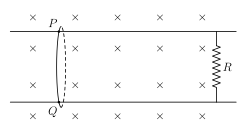
Consider a situation shown in the figure below. The wire PQ has mass m, resistance r and can slide on the smooth, horizontal parallel rails separated by a distance l. The resistance of rails is negligible. A uniform magnetic field B exists in the rectangular region and a resistance R connects the rails outside the field region. At t = 0, the wire PQ is pushed towards right with a speed V_0. Find (i) the current in the loop at an instant when the speed of the wire PQ is V and (ii) the acceleration of the wire at this instant :
Consider a uniformly magnetized sphere of radius a and magnetization \vec{M} = M_0 \hat{z} surrounded by a vacuum region. Obtain an expression for scalar magnetic potential for r < a.