341cse-2006-subject-03-008
Paper I20 Marks
Write Ampere's circuital law, and obtain a generalised form of this law, for non-stationary case.
Search, filter, and study UPSC Civil Services & IFoS Physics past year questions with rigorous derivations, formulas, and step-by-step solutions.
Buy PYQ Solution Manual →
Write Ampere's circuital law, and obtain a generalised form of this law, for non-stationary case.
What is molecular polarizability ? Derive Clausius - Mossotti equation relatig the molecular polarizability with the dielectric constant of a dielectric material.
Starting from Maxwell's equation, \nabla . D = \rho, where D is the electric displacement density and \rho is the charge density, derive Poisson's equation. Deduce Laplace's equation for charge-free region from Poisson's equation.
(b) Describe physical significance of the displacement current considering the example of current flow through a capacitor.
(c) Use the Planck formula for the blackbody radiation u(\omega, T) = \frac{\hbar^2}{\pi^2 c^3} \frac{\omega^3}{\exp(\beta \hbar \omega) - 1} with \beta = \frac{1}{k_B T} to derive Wien's law, Rayleigh-Jeans law and Stefan-Boltzmann law.
(a) Prove the relation \nabla^2 \left( \frac{1}{|\vec{r} - \vec{r}'|} \right) = - 4 \pi \delta \left(|\vec{r} - \vec{r}'|\right) and hence show that \phi(\vec{r}) = \int \frac{\rho(\vec{r}')}{|\vec{r} - \vec{r}'|} \, d\vec{r}' is a solution of the Poisson equation \nabla^2 \phi(\vec{r}) = - 4 \pi \rho(\vec{r}).
(b) Derive approximate expressions for the potential and the radial as well as the azimuthal components of the field due to an electric dipole at points far away from it. Also derive expression and hence describe the effect of a unifrom electric field on a dipole which can rotate freely.
(b) Show that the electric and magnetic field vectors, \vec{E} and \vec{B}, in plane electromagnetic waves are mutually perpendicular in a plane normal to the direction of propagation. How are phases of \vec{E} and \vec{B} related to each other ?
What do you understand by a perfect black body? Can it be realised in practice ? Show that the ratio of the emissive power to the absorptive power for all bodies at a given temperature is equal to the emissive power of a perfectly black body.
Show that the Poynting vector \bar{S} = (\bar{E} \times \bar{H}) represents the energy flow per unit area per unit time both in magnitude and direction in case of a plane electromagnetic wave.
Find out the magnetic field inside a long solenoid carrying current i and having n turns per unit length.
A point charge q is held at a distance d in front of an infinite grounded conducting plane. What is the electric potential in front of the plane ?
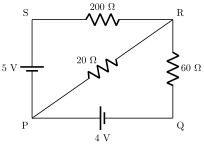
A network PQRS is connected as shown in the figure below. Apply Kirchhoff's law and show that the current flowing through the 20\ \Omega resistor PR is 0.029 A.
What is the volume density of the charge in a region of space, where the electrostatic potential is given by V = a - b (x^2 + y^2) - c \ln (x^2 + y^2), where a, b, c are constants ?
Define the strength of a magnetic shell and calculate the magnetic potential at any neighbouring point due to this shell. Does the potential depend on the shape of the shell ?
Given the temperature of the Sun's surface T = 5755\text{ K}, radius of the Sun 6.9 \times 10^5\text{ km}, distance between the Earth and the Sun 1.5 \times 10^8\text{ km}. Estimate the solar constant (i.e. the energy received per sec per unit area of the Eath's surface). Assume \sigma = 5.7 \times 10^{-8}\text{ W/m}^2\text{-K}^4.
What are the vector and scalar potentials ? Derive Maxwell's wave equations in terms of these potentials.
A plane wave of frequency \omega, which into two linear dielectric media. It has a normal incidence at the interface of the media. Giving appropriate for the intensities of reflected and transmitted rays.