Suppose a cavity of volume V contains blackbody radiation in equilibrium with the walls of the cavity at a temperature T. For a reversible adiabatic change of volume show that : VT^3 = \text{constant}. If the initial temperature is 2000^\circ\text{K} and the volume is increased from 10\text{ cm}^3 to 1250\text{ cm}^3, reversibly and adiabatically, what would be the final temperature of the radiation ?
In deriving radiation laws, we consider a cubical container of volume V containing a photon gas in equilibrium. Calculate the differential number of allowed normal modes of frequency \omega.
A sphere of homogeneous linear dielectric material is placed in an otherwise uniform electric field \bar{E}_o. Find the electric field inside the sphere.
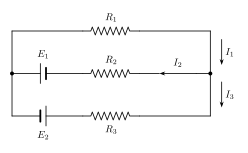
Explain Kirchoff's circuit laws. Using Kirchoff's laws find currents I_1, I_2 and I_3 in the circuit shown below for R_1 = 100\ \Omega, R_2 = 200\ \Omega, R_3 = 300\ \Omega, E_1 = 3\text{ V}, E_2 = 4\text{ V}.
Compute the electrostatic energy of a conducting solid sphere of radius R and having total charge Q using the expression for the electrostatic energy in terms of the electric field \bar{E} of the above sphere.
When connected in series, L_1, C_1 have the same resonant frequency as L_2, C_2 also connected in series. Prove that if all these circuit elements are connected in series, the new circuit will have the same resonant frequency as either of the circuits first mentioned.
Using Ampere's Law and continuity equation, show that the divergence of the total current density is zero.
For initial current conditions I=I_0 and \frac{dI}{dt}=0 at t=0, show that the time dependent current in the critical damping case for an LCR circuit is given by I=I_0\left(1+\frac{\gamma t}{2}\right)e^{-\gamma t/2} where \gamma=\frac{R}{L}, \omega_0^2=\frac{1}{LC}, \omega=\sqrt{\omega_0^2-\frac{\gamma^2}{4}} and \tan\delta=\frac{-\gamma}{2\omega}.
Using Poisson equation and spherical co-ordinates, calculate the density of continuous charge distribution that will provide the Yukawa potential \phi = \frac{\exp(-\alpha r)}{r}, where \alpha is a constant.
Define a black body. How can we realise a black body in practice ? Derive expression for Planck's radiation law.
Sea water has resistivity 0\cdot 3\ \Omega\text{m} and its dielectric constant is 81. Calculate the ratio of the amplitudes of the conduction and polarisation current intensities when the applied field is oscillating at 100\text{ MHz}.
A plane electromagnetic wave is given by E_z = a \cos \omega x \cos \omega t and H_y = - a \sin \omega x \sin \omega t. Evaluate the instantaneous value of the Poynting vector \vec{S} and show that <\vec{S}> = 0.
The electric field of a plane e.m. wave travelling along the z-axis is \vec{E}=(E_{0x}\hat{x}+E_{0y}\hat{y})\sin(\omega t-kz+\phi). Determine the magnetic field.
For a uniform wire of length L and radius a having a potential difference V between the ends and a current I along it, calculate the energy per unit time delivered to the wire by Poynting vector.
With reference to ferromagnetic materials, explain the terms hysteresis and hysteresis loops.
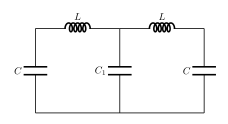
Consider the following coupled inductor - capacitor circuit:
Calculate the ratio of the frequencies of the anti-symmetric and symmetric modes \omega_a/\omega_s. \left(\text{Given } k=\frac{1}{LC},\ k'=\frac{1}{LC_1}\right)
When the current in an \text{R}-\text{L} circuit is decaying, what fraction of the original energy stored in the inductor has been dissipated after 2\cdot 3 time constant ?
A series LCR circuit has resonant frequency \omega_0 and a large quality factor Q. Write down in terms of R, \omega, \omega_0 and Q, its (i) impedance at resonance, (ii) impedance at half-power points and (iii) the approximate forms of its impedance at low and high frequencies.
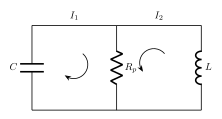
Consider the equation for a series RLC circuit and compare this to the parallel resonant circuit shown below:
Calculate the value of R_p if a series RLC circuit and the parallel RLC circuit are to have same equations for the potential of capacitance while they both have the same L, C and Q with Q being the total charge.
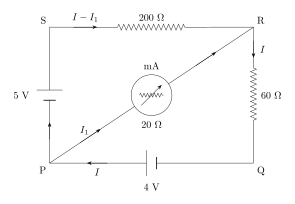
In the circuit diagram shown below, calculate the current passing through the milliammeter.