Discuss the anomalous magnetic splitting of sodium D-lines with necessary illustration (no deduction is required). Identify the polarization of each component line. What condition needs to be satisfied for this splitting to take place?
What is nuclear precession? How is it used in the principle of working of an NMR?
Discuss the theory of rotational and vibrational spectra of diatomic molecules. What is the difference between fluorescence and phosphorescence?
The most intense vibrational bands of CO and HCl molecules have the wave numbers 2\cdot 143 \times 10^5\text{ m}^{-1} and 2\cdot 886 \times 10^5\text{ m}^{-1} respectively. Calculate the force constants of these molecules.
Show that for pure rotational spectrum of a diatomic molecule the wave number difference between the consecutive lines \Delta \bar{\nu} = \frac{\hbar}{2\pi Ic}, where I is the moment of interia.
How many different wavelengths may be observed in the spectrum from a hydrogen sample, if the atoms are excited to states with principle quantum number n ?
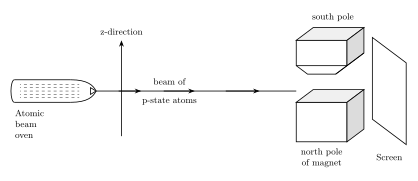
In an atomic physics experiment a beam of p-state atoms is passed through a non-uniform magnetic field. After passing through the magnetic field the atomic beam strikes at the screen and is detected as shown in the given figure. Obtain an expression of the force acting on the p-atoms beam due to gradient in the magnetic field acting along z-axis as shown. Also comment on the number of spots that are found on the screen as an outcome and explain.
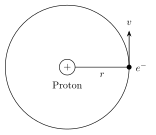
Consider an electron circulating around a proton (as shown in figure) in a circular orbit of radius, r. Assuming the motion of orbiting electron equivalent to an electrical current loop, find the expression for the ratio of magnetic moment to the angular momentum of the system and estimate the numerical value of this ratio.
Discuss the fine structure of hydrogen spectrum. How is it of importance in the astronomical observations?
Describe the importance of L-S and J-J coupling in atomic spectroscopy. What are experimental evidences of their existence?
Explain the principle of Nuclear Magnetic Resonance (NMR) with the help of an energy level diagram. Give examples of nuclei which exhibit NMR. What major inferences can be drawn from an NMR spectra?
In an NMR experiment, hydrogen atoms are subjected to a magnetic field of 5.0\ \mathrm{T}. Determine the difference in energy (\mathrm{kJ/mol}) between two spin states of the nuclei of hydrogen atom and the frequency of radiation required for NMR.
Show that the lines in the absorption spectra corresponding to the rotational transitions from two adjacent energy levels of a medium sized molecule at room temperature have comparable intensities.
State Franck-Condon principle. Define Franck-Condon factors. Using schematic diagram, explain the decay of excited states leading to the phenomena of fluorescence and phosphorescence.
Consider two electrons system in (3p)^1(4s)^1 configuration. Derive the allowed energy states of the system in (i) LS coupling and (ii) jj coupling sketching the energy level diagram in each case. Name the interactions which are responsible for different splittings.
What is the main inference drawn from the Stern Gerlach experiment ? What would be the change in the result in the following cases :
(i) electron spin is \frac{3}{2}\hbar instead of \frac{\hbar}{2}.
(ii) a beam of neutral atoms is passed through a homogeneous magnetic field.
Given the force constant of HCl molecule = 516\ \mathrm{N\,m}^{-1}, determine the wave number of the fundamental mode of vibration of the molecule. How many transition lines one can expect in the vibration spectra of HCl molecule at room temperature?
Explain Stokes and anti-Stokes Raman scattering with the help of energy level diagram. For a diatomic molecule, obtain expressions for transition energies of its Raman spectra with rotational fine structure and hence the wave numbers of the Stokes lines.
Explain why lines in some Raman spectra are found to be plane polarized to different extents even though the exciting radiation is completely unpolarized?