(i) The quantities of rotatory motion are analogous to those of translatory motion. Write the corresponding equations of translatory and rotatory motion. (ii) Describe the theorems of perpendicular and parallel axes in case of a plane lamina.
In a reference frame S, an event 1 occurs at the origin at t = 0 and another event 2 occurs at x = 4000\text{ m} and time t = 5 \times 10^{-6}\text{ s}. Find the time interval between the events as registered by clock in a frame S' moving with speed v = 0 \cdot 6 \, c relative to S along the common X-X' axis, the origin coinciding at t = t' = 0\,.
What are the consequences of Lorentz transformations on length and time when observed from a frame moving at relativistic velocities ?
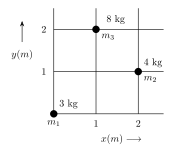
What are the coordinates of the centre of mass of the system of masses shown in the figure?
A force \vec{F} is given by \vec{F} = x^2 y \hat{x} + z y^2 \hat{y} + x z^2 \hat{z}. Determine whether or not the force is conservative.
Calculate the gravitational self-energy of the Earth. Given : Mass of Earth M_e = 6 \times 10^{24}\text{ kg} and the Radius of Earth R_e = 6\cdot4 \times 10^6\text{ m}
Define streamline flow of a fluid. Using the equation of continuity for an isotropic fluid, find different components of total energy per unit volume.
Why can Electron-Positron pair production through a high energy photon not take place in vacuum?
Calculate the velocity of a particle having kinetic energy four times the rest mass energy.
A particle of mass m moves under the action of a central force whose potential is V(r) = Kmr^4 (K > 0). Calculate the kinetic energy for which the orbit will be circle of radius R, about the origin.
(i) Derive the expressions for gravitational potentials at a point (I) outside the spherical shell, (II) inside the spherical shell. (ii) Calculate the escape velocity of a body of mass 10\text{ kg} from the surface of Moon \left( g_{\text{Moon}} = \frac{1}{6} g_{\text{Earth}} \right). Mass of Moon = 7\cdot3 \times 10^{22}\text{ kg} Radius of Moon = 1\cdot7 \times 10^6\text{ m}
The wavelength of a prominent X-ray line from a copper target is 0.1512\,\mathrm{nm}. The radiation, when diffracted with (111) plane of a crystal with fcc structure, corresponded to a Bragg angle of 20.2^\circ. If the density of the crystal is 2698\,\mathrm{kg/m^3} and atomic weight is 26.98\,\mathrm{kg/kmol}, calculate the Avogadro number.
Considering atoms hard, uniform spheres, find the number of atoms per unit cell and packing fraction for simple cubic, bcc and fcc structures.
Explain the drawbacks of Einstein's theory of specific heat and how it was overcome by Debye.
(i) Diamond and silicon have similar band structure. Why is diamond an insulator while silicon a semiconductor? (ii) An insulator has an optical absorption which occurs for all wavelengths lesser than 1400\text{ \AA}. Find the width of the forbidden energy band for the insulator.
State the basic conditions for oscillations in a feedback amplifier. What are the primary requirements to obtain steady oscillations at a fixed frequency?
Show that for an n-type semiconductor, the Fermi level lies midway between the donor states and the conduction band edge at low temperature (assuming E_v=0).
What is Meissner effect? Show that the Maxwell's equation is in contradiction to the Meissner effect. What are the inferences from this contradiction?
(i) Distinguish between d.c. Josephson effect and a.c. Josephson effect. Show that Josephson effect exhibits the quantum interference phenomenon on macroscopic scale. (ii) The critical magnetic field of superconducting niobium is 1 \times 10^5\text{ A/m} at 8\text{ K} and 2 \times 10^5\text{ A/m} at 0\text{ K}. Calculate the critical transition temperature (T_c) of niobium.