For the n^{\text{th}} state of linear harmonic oscillator, evaluate the uncertainty product (\Delta x) \cdot (\Delta p).
15 Marks
For the n^{\text{th}} state of linear harmonic oscillator, evaluate the uncertainty product (\Delta x) \cdot (\Delta p).
The time independent wave function of a system is \psi(x) = A \exp(ikx), where k is a constant. (i) Is this wave function normalizable in the domain -\infty < x < \infty? (ii) Calculate the probability current density for this function.
Calculate the zero point energy for a particle in an infinite potential well for the following cases : (i) a 100\text{ g} ball confined on a 5\text{ m} long line. (ii) an oxygen atom confined to a 2 \times 10^{-10}\text{ m} lattice. (iii) an electron confined to a 10^{-10}\text{ m} atom. Why zero point energy is not important for macroscopic objects ? Comment.
A particle constrained to move along x-axis in the domain 0 \le x \le L has a wave function \psi(x) = \sin \left( \frac{n \pi x}{L} \right), where n is an integer. Normalize the wave function and evaluate the expectation value of momentum of the particle.
Consider the potential V(x) = \begin{cases} 0, & 0 < x < a \\ \infty, & \text{elsewhere} \end{cases} (a) Estimate the energies of the ground state as well as those of the first and the second excited states for (i) an electron enclosed in a box of size a = 10^{-10}\text{ m}. (ii) a 1\text{ g} metallic sphere which is moving in a box of size a = 10\text{ cm}. (b) Discuss the importance of the Quantum effects for both of these systems. (c) Estimate the velocities of the electron and the metallic sphere using uncertainty principle.
Evaluate the most probable distance of the electron of the hydrogen atom in its 2p state. What is the radial probability density at that distance ?
By assuming the nucleus as a cubical box of length equal to the nuclear diameter 10^{-12}\text{ cm}, calculate the kinetic energy of the highest level occupied nucleon of iron-56 nucleus.
A particle of mass m is in a spherically symmetric attractive potential of radius a. Find the minimum depth of the potential needed to have two bound states of zero angular momentum.
Consider a stream of particles of mass m each moving in the positive x-direction with kinetic energy E towards the potential barrier V(x) = 0 \quad \text{for } x \le 0 V(x) = \frac{3E}{4} \quad \text{for } x > 0 Find the fraction of particles reflected at x = 0.
(i) Derive an expression for the period of Bloch oscillation for a one-dimensional crystal having lattice period a and electric field \varepsilon. (ii) Consider an electron in a perfectly periodic lattice, wherein the energy-wavenumber relationship in the first Brillouin zone is expressed as E = \frac{\hbar^2 k^2}{5\mathrm{m}_e} where \mathrm{m}_e is the mass of an electron in free space. Find the effective mass of the electron and hence write down the time-independent Schrodinger equation for the electron. Also determine the velocity of the electron. Ignore all interactions except between the electron and the lattice.
Find the condition at which de Broglie wavelength equals the Compton wavelength for a particle.
Consider a particle of mass m and charge q moving under the influence of a one dimensional harmonic oscillator potential. Assume it is placed in a constant electric field E. The Hamiltonian of this particle is therefore given by H = \frac{p^2}{2m} + \frac{1}{2} m \omega^2 X^2 - qEX. Obtain the energy expression and the wave function of the n\text{th} excited state of the particle.
Explain how we can produce refrigeration without using a compressor.
What is the concept of negative temperature in statistical mechanics? Explain in brief.
Using Zeroth law of thermodynamics, introduce the concept of temperature. Explain how the isotherms of two different systems can be drawn.
(i) Define Joule-Kelvin coefficient. Write it in its mathematical form. (ii) Determine the Joule-Kelvin coefficient for a van der Waals gas. Hence, obtain an expression for temperature of inversion. Discuss the conditions under which heating or cooling is produced.
Write down the expressions for the Fermi-Dirac distribution and the Bose-Einstein distribution. Plot the distributions as a function of the energy.
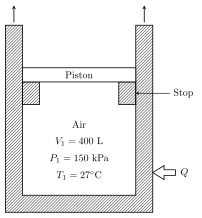
A piston-cylinder device initially contains air at 150\text{ kPa} and 27^\circ\text{C}. At this state, the piston is resting on a pair of stops, as shown in the figure, and the enclosed volume is 400\text{ L}. The mass of the piston is such that a 350\text{ kPa} pressure is required to move it. The air is now heated until the volume is doubled. Determine : (i) the final temperature, (ii) the work done by the air, and (iii) the total heat transferred to air. Given : U_{300\text{ K}} = 214\text{ kJ/kg} and U_{\text{final}} = 1113\text{ kJ/kg} Gas constant of air, R = 0\cdot287\text{ kPa.m}^3/\text{kg.K}
Explain how the state of ionization of any particular element in a star changes with varying temperatures and pressures.
Use the Maxwell-Boltzmann distribution to find the number of oxygen molecules whose velocities lie between 195\text{ m/s} and 205\text{ m/s} at 0^\circ\text{C}. The given mass of oxygen gas is 0\cdot1\text{ kg}. (Assume mass of proton to be 1\cdot66 \times 10^{-27}\text{ kg})