Explain the cause of Rayleigh scattering. How does the amount of scattering depend on the wavelength of light ? How does Rayleigh scattering explain : (i) the blue colour of sky at day time ? (ii) the red colour at dusk ?
15 Marks
Explain the cause of Rayleigh scattering. How does the amount of scattering depend on the wavelength of light ? How does Rayleigh scattering explain : (i) the blue colour of sky at day time ? (ii) the red colour at dusk ?
Current 'I' is passing through an infinite solenoid of radius R, with n turns per unit length. Find out the vector potential (i) inside the solenoid (ii) outside the solenoid.
State Biot--Savart law and write its mathematical form. In case of distributed current sources, write this expression for line current, surface current and volume current.
Define electromagnetic field strength tensor F_{\mu\nu}. Express it in terms of components of electric and magnetic fields.
Obtain the general boundary conditions for fields E, B, D and H at a boundary between two different media carrying charge density \sigma or a current density K.
Distinguish between self-inductance and mutual inductance. Calculate the self-inductance of a solenoid of length 'l', area of cross-section 'A' having N turns.
Obtain an expression for Poisson's and Laplace's equations in electrostatics.
How does Planck's law resolve the ultraviolet catastrophe predicted by classical physics? Calculate the average energy \bar{\varepsilon} of an oscillator of frequency 0.60 \times 10^{14}\text{ s}^{-1} at T = 1800\text{ K}, treating it as (i) classical oscillator and (ii) Planck's oscillator.
Briefly explain electronic, ionic and orientational polarisation. The polarisability of ammonia molecule is found to be 2.42 \times 10^{-39}\text{ C}^2\text{ m/N} and 1.74 \times 10^{-39}\text{ C}^2\text{ m/N} at 309\text{ K} and 448\text{ K} respectively. Calculate the orientation polarisability for each temperature.
A uniform plane wave with \vec{E} = E_x \hat{a}_x propagates in a lossless medium (\varepsilon_r = 4, \mu_r = 1, \sigma = 0) in the z-direction. Assume that E_x is sinusoidal with a frequency 100\text{ MHz} and has a maximum value of 10^{-4}\text{ (V/m)} at t = 0 and z = \frac{1}{8}\text{ (m)}. (i) Write the expression for instantaneous E for any t and z. (ii) Write the expression for instantaneous H. (iii) Determine the locations where E_x is a positive maximum, when t = 10^{-8}\text{ (s)}.
Using Maxwell's equations, obtain Poisson's equation and Laplace's equation. The region -\frac{\pi}{2} < \frac{z}{z_0} < \frac{\pi}{2} has a charge density \rho = 10^{-8} \cos \left( \frac{z}{z_0} \right) (\text{C/m}^3). Elsewhere the charge density is zero. Find the electric potential V and electric field E from the Poisson's equation.
The magnitude of the average electric field normally present in the Earth's atmosphere just above the surface of the Earth is about 150\text{ N/C}, directed radially inward, toward the centre of the Earth. What is the total net surface charge carried by the Earth? Assume the Earth to be a conductor. (The radius of the Earth is 6.37 \times 10^6\text{ m})
Consider a uniformly magnetized sphere of radius a and magnetization \vec{M} = M_0 \hat{z} surrounded by a vacuum region. Obtain an expression for scalar magnetic potential for r < a.
What is anomalous dispersion? How does the phenomenon of dispersion lead to the separation of white light into its constituent colours?
For a vector potential \vec{A}, \vec{\nabla} \cdot \vec{A} = -\frac{\mu_0}{4\pi} \cdot \frac{Q}{r^2} where Q is a constant of appropriate dimension. Calculate the corresponding scalar potential \phi (\vec{r}, t), that make \vec{A} and \phi to satisfy Lorentz gauge.
In spherical coordinates, V = -25\text{ V} on a conductor at r = 2\text{ cm} and V = 150\text{ V} on another conductor at r = 35\text{ cm}. The space between the conductors is a dielectric for which \varepsilon_r = 3.12. Find the surface charge densities on the conductors.
Find the magnetic field strength (H) at the centre of a square current loop of side L.
A parallel plate capacitor with circular plate of radius (R = 5\text{ cm}) is being charged. Find out the displacement current. Given : \varepsilon_0 = 8.9 \times 10^{-12}\text{ C}^2/\text{Nm}^2, \frac{dE}{dt} = 10^{12}\text{ V/m}.
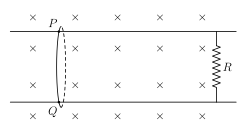
Consider a situation shown in the figure below. The wire PQ has mass m, resistance r and can slide on the smooth, horizontal parallel rails separated by a distance l. The resistance of rails is negligible. A uniform magnetic field B exists in the rectangular region and a resistance R connects the rails outside the field region. At t = 0, the wire PQ is pushed towards right with a speed V_0. Find (i) the current in the loop at an instant when the speed of the wire PQ is V and (ii) the acceleration of the wire at this instant :
Calculate the speed and radius of \alpha-particles of energy 5\cdot 998\text{ MeV} emitted into a magnetic field B = 10^4\text{ Wb m}^{-2}. Given that the mass of proton is 1\cdot 673 \times 10^{-27}\text{ kg}.