A conducting sphere of radius 5\,\mathrm{cm} has a total charge of 12\,\mathrm{nC} uniformly distributed on its surface in free space. Determine the displacement vector \vec{D} on its surface and outside at a distance r from the centre of the sphere.
Under one-dimensional configuration, the charge density is given by \rho(x)=\dfrac{\rho_0x}{5}, where \rho_0 is a constant charge density. If the electric field \lvert\vec{E}\rvert=0 at x=0 and potential V=0 at x=5, determine V and \lvert\vec{E}\rvert.
Derive the equation that represents Poynting's theorem. What is its physical significance?
A plane electromagnetic wave propagating along +\hat{z} direction is incident normally on the boundary at z=0 between medium A(z<0) and medium B(z>0). Determine the reflection coefficient and transmission coefficient for the wave.
What are the characteristic features of Rayleigh scattering? A very thin monochromatic beam of light is incident on a particle. Suggest a simple experimental method to ascertain whether the scattering by the particle is of Rayleigh type.
A radio station transmits electromagnetic waves isotropically with an average power of 200\,\mathrm{kW}. Determine the average magnitude of the maximum electric field at a distance of 5\,\mathrm{km} from it.
Two spheres A and B having same temperature T are kept in the surroundings of temperature T_0. Consider T > T_0. The spheres are made of same material but have different, radii r_A and r_B. Using Stefan - Boltzmann distribution, determine which of these will lose heat by radiation faster.
Using Planck's radiation law, deduce Wien's displacement law. How does this law enable one to estimate the surface temperature of the Sun or a star?
A series RLC circuit has a resistance of 100\Omega and an impedance of 210\Omega. If this circuit is connected to an a.c. source with an r.m.s. voltage of 220\ \mathrm{V}, how much is the average power dissipated in the circuit?
A series RLC circuit has R=2\Omega. The energy stored in the circuit decreases by 1\% per period of oscillation. Its natural undamped frequency is 2\,\mathrm{kHz}. Determine the values of inductor L and the quality factor.
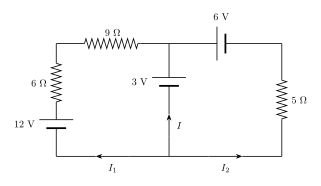
In the circuit given below, find the values of currents I_1, I_2 and I.
Starting from Maxwell's equation, obtain the wave equation for the electric field \vec{E} in free space and appropriate wave equation for the electric field \vec{E}=E_z(x,y,z)\hat{z}.
Show that the energy flow due to a plane electromagnetic wave propagating along z-direction in a dielectric medium is given by \hat{z}\frac{k}{\omega\mu}E_0^2\cos^2(kz-\omega t), where \mathbf{k} and \omega are the propagation vector and angular frequency, E_0 is electric field amplitude, \mu is the relative permeability of the medium.
In deriving radiation laws, we consider a cubical container of volume V containing a photon gas in equilibrium. Calculate the differential number of allowed normal modes of frequency \omega.
State and explain Stefan-Boltzmann Law. Show that \log P = \log K + 4\log R, where P is the power emitted by black body and R is the resistance of the black body, K is a constant.
When connected in series, L_1, C_1 have the same resonant frequency as L_2, C_2 also connected in series. Prove that if all these circuit elements are connected in series, the new circuit will have the same resonant frequency as either of the circuits first mentioned.
Using Ampere's Law and continuity equation, show that the divergence of the total current density is zero.
For initial current conditions I=I_0 and \frac{dI}{dt}=0 at t=0, show that the time dependent current in the critical damping case for an LCR circuit is given by I=I_0\left(1+\frac{\gamma t}{2}\right)e^{-\gamma t/2} where \gamma=\frac{R}{L}, \omega_0^2=\frac{1}{LC}, \omega=\sqrt{\omega_0^2-\frac{\gamma^2}{4}} and \tan\delta=\frac{-\gamma}{2\omega}.
The electric field of a plane e.m. wave travelling along the z-axis is \vec{E}=(E_{0x}\hat{x}+E_{0y}\hat{y})\sin(\omega t-kz+\phi). Determine the magnetic field.
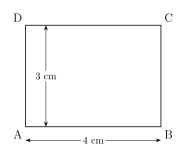
ABCD is a rectangle in which charges of +10^{-11}\,\mathrm{C}, -2\times10^{-11}\,\mathrm{C} and 10^{-11}\,\mathrm{C} are placed at corners B, C and D, respectively.
Calculate the potential at the corner A and the work done in carrying a charge of 2 coulombs to A.